
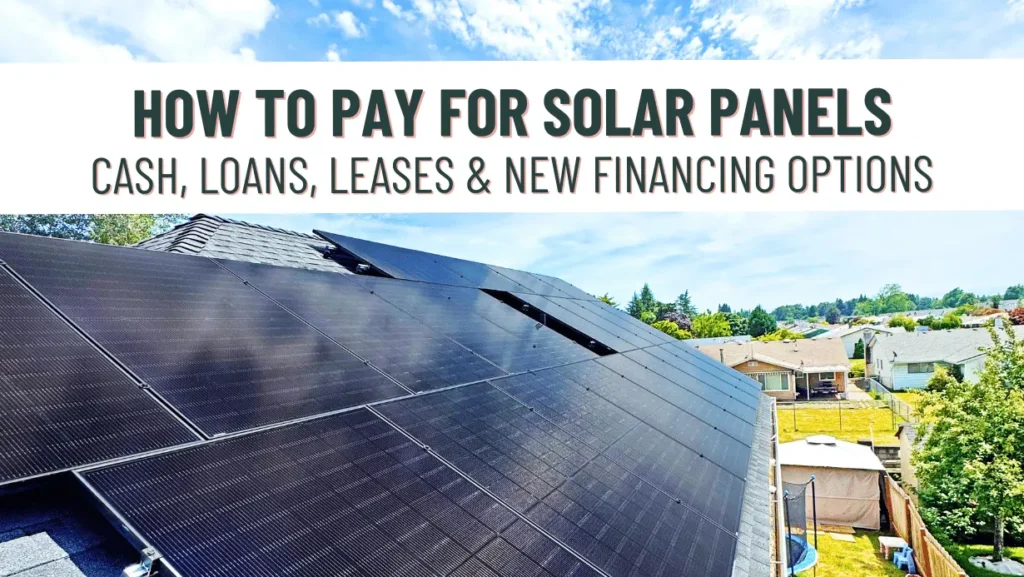
One of the biggest questions homeowners have when considering solar is simple: How am I going to pay for it?
Installing solar panels is an investment in your home and energy future. While the potential for lower electricity bills and long-term savings is appealing, the upfront cost can make some homeowners hesitant to take the next step.
The good news? You don’t necessarily need a large amount of money saved up to go solar.
Today’s homeowners have more solar financing options than ever, including traditional solar loans, leasing programs, and newer financing arrangements that make going solar more accessible.
Whether your goal is to maximize long-term savings, lower your monthly electricity expenses, or avoid a large upfront investment, there’s likely a payment option worth exploring.
Let’s break down four of the most common ways to pay for solar panels, how each works, and which might be the best fit for your home and budget.
In This Article:
- Option 1: Paying Cash
- Option 2: Solar Loans
- Option 3: Solar Leases, PPA, Third-Party Ownership
- Option 4: Propel Solar Financing
- Other Ways to Finance Solar
- Comparing Solar Financing Options
- Can Solar Incentives Make Solar More Affordable?
- What to Consider Before Choosing Payment Option
- FAQs
Estimate your total savings, payments, and total energy usage with our FREE solar calculator.
Option 1: Paying Cash for Solar Panels
Purchasing your solar panel system outright is the simplest way to pay for solar. You cover the full installation cost upfront, and the system belongs to you from day one.
Although this requires a larger initial investment, paying cash generally offers the greatest potential for long-term financial returns.
Benefits of Paying Cash
- No interest or financing fees: One of the biggest advantages of paying cash for your solar panels is avoiding the additional costs associated with borrowing money. Without interest charges or loan fees, you keep your total investment lower.
- Greater long-term savings: Since you don’t have a monthly solar loan or lease payment when paying cash, the electricity your panels generate can translate more directly into savings on your utility bills.
- Full ownership and control: When you pay cash for your solar panels, you own the solar panels and equipment from the beginning. This gives you greater flexibility over your system and how you manage it.
- A potentially faster payback period: Without financing costs, paying cash for your solar panels can help you recover your initial investment sooner through electricity savings and greatly shorten your payback period and increase your ROI.
What Are the Drawbacks?
The obvious downside of paying cash for your solar is the upfront expense. Depending on the size, equipment, and complexity of your installation, purchasing solar can require a substantial financial commitment.
You also need to consider whether that money might be better used for other investments, home improvements, or expenses.
As the system owner, you’ll generally be responsible for ongoing maintenance and repairs, although equipment warranties, workmanship warranties, and service plans can help protect your investment.
Best for: Homeowners with available savings who want to maximize long-term financial returns and own their solar system outright.
Option 2: Solar Loans — Own Your System with Monthly Payments
If paying cash isn’t practical, a solar loan can make solar ownership much more accessible.
Similar to financing a vehicle or home improvement, a solar loan allows you to spread the cost of installing solar panels over time through monthly payments.
Rather than paying thousands of dollars upfront, qualifying homeowners may be able to finance their solar system with little or no money down.
And unlike leasing, you own the solar panels from the beginning, subject to any lender security interest.
Benefits of Solar Loans
- Low or no upfront investment: Many solar loan programs allow qualified homeowners to install solar without making a substantial down payment.
- Predictable monthly payments: Fixed-rate solar loans provide consistent payments that can make budgeting easier and more predictable.
- Potential monthly savings: Depending on your electricity usage, system production, utility rates, and loan terms, the reduction in your electric bill may offset some or all of your monthly loan payment.
- Long-term ownership: Once your solar loan is paid off, you continue benefiting from the electricity your solar system generates without a solar financing payment.
What Should You Consider Before Financing Solar?
Solar loans come with additional expenses that can affect your overall savings.
Interest rates, financing fees, and loan duration all influence the total amount you’ll ultimately pay for your solar installation.
For example, a loan with a longer repayment period may offer a lower monthly payment, but it can also result in more interest paid over the life of the loan.
Some solar financing programs also include dealer fees that increase the financed project cost. That’s why it’s important to compare both the monthly payment and the total repayment amount rather than focusing exclusively on advertised interest rates.
You should also consider what happens if you decide to sell your home before paying off your loan.
For more information, read our guide on what happens to your solar loan when you sell your home.
Best for: Homeowners who want the benefits of solar ownership without paying the full installation cost upfront.
GET YOUR FREE SOLAR ANALYSIS
Request your FREE solar analysis now!
We’ll evaluate your roof, sun exposure, electricity usage, incentives, and more to help you decide if solar is right for you!
Option 3: Solar Leases & Power Purchase Agreements (Third-Party Ownership)
What if you could benefit from solar electricity without purchasing the panels or taking out a traditional solar loan?
That’s the idea behind Third-Party Ownership (TPO) solar, an increasingly popular option for homeowners who want to avoid the upfront costs and some of the responsibilities associated with owning a solar system.
Under a TPO arrangement, a third-party provider owns the solar equipment installed on your property. Instead of purchasing the system, you make payments according to an agreement with that provider.
There are two common types of TPO agreements.
Solar Leases
With a solar lease, you pay an agreed monthly amount to use the solar panel system installed on your home.
Your lease payments may be fixed or may increase periodically according to the agreement.
Power Purchase Agreements (PPAs)
With a Power Purchase Agreement, you pay for the electricity your solar panels produce, typically at an agreed rate per kilowatt-hour.
Rather than purchasing the equipment, you’re essentially purchasing solar electricity from the company that owns it.
Benefits of Third-Party Ownership (TPO)
- Little or no money down: Many TPO programs allow qualified homeowners to go solar without a substantial upfront investment.
- Potential immediate savings: Depending on your agreement and utility costs, your combined solar and utility expenses could be lower from the beginning.
- Reduced maintenance responsibilities: The third-party owner generally handles covered system repairs, monitoring, and maintenance according to the contract.
- Greater budget predictability: Contracted payment structures can provide more certainty about a portion of your future electricity expenses.
What Are the Drawbacks?
Because you don’t own the solar equipment, you generally won’t receive the same long-term ownership benefits as someone who purchases their solar system.
Some leases and PPAs also include annual payment increases, known as escalators, which can affect your future savings.
You’ll also need to understand the contract’s length, maintenance coverage, equipment purchase options, and transfer requirements if you sell your home.
Best for: Homeowners who want to reduce upfront expenses, avoid purchasing the equipment, and have a third-party provider handle covered system maintenance.
Want to learn more? Explore our guides to Third-Party Ownership solar and TPO vs. Solar Ownership.
Option 4: Propel Solar Financing — A New Path to Solar Ownership
Solar financing continues to evolve, with newer programs offering alternatives to traditional loans and leases.
One such option is Propel, a financing program Green Ridge Solar is introducing to help eligible homeowners access solar with a different payment and ownership structure.
Propel combines some benefits of third-party ownership with a defined pathway toward eventually owning your solar equipment.
How Does Propel Financing Work?
Propel solar financing uses what’s called a prepaid Energy Services Agreement (ESA).
Although that may sound complicated, the basic concept is relatively straightforward.
Instead of purchasing your solar equipment immediately, a third-party provider, such as SolSource, initially owns the system. The energy services agreement is prepaid, with financing available to cover that arrangement and a planned future ownership transfer.
Here’s how it generally works:
- Design your solar system. Green Ridge Solar or your solar company evaluates your home, electricity usage, and energy goals to determine whether Propel is an eligible financing option.
- Finance the agreement. A qualifying financing arrangement covers the prepaid energy services agreement and a funded early buyout option, allowing the homeowner to make scheduled loan payments.
- Benefit from initial-term protection. The third-party financing partner initially owns the system and provides performance and limited service protections as outlined in the agreement.
- Follow the path to ownership. After five years, the program provides a defined opportunity for system ownership to transfer to the homeowner, subject to the agreement’s terms. Financing payments may continue after ownership transfers.
What Makes Propel Different?
One of Propel’s distinguishing features is its approach to federal solar incentives.
Although the traditional federal residential solar tax credit is no longer available for new homeowner-owned installations, qualifying third-party-owned solar projects may still benefit from applicable business-related federal tax incentives.
Under Propel, SolSource, as the initial system owner, can incorporate the value of qualifying incentives into the overall financing arrangement. The homeowner does not personally claim those business tax credits.
Propel is also designed to offer:
- Predictable financing payments: Fixed loan payments without traditional annual lease-payment escalators.
- An alternative to conventional solar loans: A prepaid agreement structure that may improve project affordability.
- A pathway to ownership: The opportunity to take ownership after the initial five-year period under the agreement.
- Initial performance protections: Covered service and performance provisions during the applicable agreement period.
Is Propel Right for You?
Propel may appeal to homeowners who want the potential financial benefits of solar ownership but are interested in a financing structure that takes advantage of eligible third-party ownership incentives.
However, Propel isn’t the same as a conventional solar loan or a traditional lease. It’s important to compare the full financing cost, ownership transfer provisions, available service protections, and long-term payment obligations before making a decision.
Program eligibility, equipment requirements, and financing terms vary.
Best for: Homeowners who want an alternative to conventional solar loans, predictable payments, and a structured opportunity to eventually own their solar system.
Chat with our solar & battery experts to see how much you could save with solar & battery.
Also learn how battery backup could keep you, your family, & business safe & sound in power outages.
Are There Other Ways to Finance Solar Panels?
While cash purchases, solar loans, TPO arrangements, and Propel represent several important payment options, they’re not the only ways homeowners can finance solar.
Some homeowners also consider:
- Home equity loans: Borrowing against available equity in your home, generally with structured repayment terms.
- Home Equity Lines of Credit (HELOCs): Using an available credit line secured by your home to help pay for a solar installation.
- Personal loans: Financing a solar installation through an unsecured loan from a bank, credit union, or other lender.
Each option has different interest rates, fees, qualifications, and financial risks. Home equity financing, for example, uses your home as collateral, while some HELOCs feature variable interest rates.
If you’re considering one of these approaches, compare its full cost and risks against available solar-specific financing offers.
Comparing Solar Financing Options: Which Is Best?
With so many choices, how do you know which solar payment option makes the most sense?
The biggest differences generally come down to how much you pay upfront, who owns the system, your monthly payment obligations, and the potential for long-term savings.
Here’s a simplified comparison:
| Payment Option | System Ownership | Upfront Cost | Ongoing Payments | Potential Savings & ROI |
|---|---|---|---|---|
| Cash Purchase | Homeowner from installation | Full purchase price | No financing payments | Typically the highest potential lifetime savings and strong long-term ROI, without financing costs |
| Solar Loan | Homeowner from installation | Often low or $0 | Monthly loan payments | Strong long-term savings potential, but interest and financing fees reduce overall returns |
| Solar Lease / PPA | Third-party provider | Often low or $0 | Lease or electricity payments | Potential immediate monthly savings, but typically lower long-term financial benefits than ownership |
| Propel Financing | Third party initially, with ownership pathway | Depends on program terms | Financing payments if a loan is used | Potential immediate and long-term savings, with future ownership benefits; total returns depend on financing and contract terms |
Which Option Offers the Most Long-Term Savings?
Paying cash typically offers the strongest potential for long-term financial returns because you avoid interest charges and financing fees.
However, solar loans can still provide substantial long-term savings while allowing homeowners to preserve their available cash.
Which Option Has the Lowest Upfront Cost?
Solar loans and third-party ownership programs often allow qualified homeowners to go solar with little or no money down.
Propel may also offer an affordable financing alternative depending on eligibility and program terms.
However, remember that a lower upfront cost doesn’t necessarily mean a lower total cost.
It’s important to compare both initial expenses and the full cost of the financing arrangement.
Which Option Requires the Least Maintenance Responsibility?
Traditional TPO arrangements generally shift covered maintenance and service responsibilities to the third-party owner.
With homeowner-owned systems, maintenance becomes the homeowner’s responsibility, although warranties and ongoing service programs can provide additional support.
Propel provides specified protections during its initial agreement period, with responsibilities potentially changing when ownership transfers.
Which Option Is Best Overall?
There isn’t one financing option that works best for every homeowner.
If your primary goal is maximizing long-term financial returns, purchasing with cash may provide the greatest potential savings.
If you’d prefer to preserve your savings while still owning your equipment, a solar loan may be more attractive.
If you’re primarily interested in lowering electricity expenses without a substantial upfront investment, TPO could be worth considering.
And if you’re interested in an alternative financing structure with a pathway toward eventual ownership, Propel may offer another compelling option.
The best approach is to compare realistic monthly savings, total lifetime costs, and estimated long-term financial benefits for each option using the same solar system and energy assumptions.
Can Solar Incentives Make Your System More Affordable?
Solar incentives can play an important role in reducing solar installation costs, but the programs available to homeowners have changed considerably over time.
What Happened to the Federal Solar Tax Credit?
For years, eligible homeowners could claim a federal Residential Clean Energy Credit (solar tax credit) equal to 30% of qualifying solar installation costs.
However, legislation enacted in 2025 ended that credit for new systems placed in service after December 31, 2025. Read more about that legislation and its impacts.
That means homeowners installing new solar panels in 2026 and beyond generally cannot claim the former 30% federal residential solar tax credit.
But the expiration of that credit doesn’t mean solar is no longer financially worthwhile.
Homeowners can still benefit from electricity savings, eligible state and utility incentives, and financing options that may help reduce upfront costs.
As discussed above, certain third-party ownership arrangements may also incorporate the value of business-related tax incentives into their pricing, provided the project qualifies under applicable rules.
For more context, read our article examining whether federal solar incentives could return in 2027.
Oregon Solar Incentives and Rebates
Oregon homeowners may have additional opportunities to reduce their solar investment through available incentive programs.
For example, Energy Trust of Oregon (ETO) offers incentives for eligible solar and battery installations for qualifying Portland General Electric (PGE) and Pacific Power customers.
The organization also offers Solar Within Reach, which provides enhanced solar incentives for qualifying income-eligible households.
The Oregon Department of Energy (ODOE) administers a separate Solar + Storage Rebate Program, which offers rebates for solar energy and battery backup systems, whether installed together or separately. Larger rebates are available for low- and middle-income households.
Because incentive amounts, eligibility requirements, and program funding can change, it’s important to review current opportunities before making a financing decision.
Visit our regularly updated Oregon Solar, Battery & EV Charger Incentives Guide to learn more.
Estimate your total savings, payments, and total energy usage with our FREE solar calculator.
What Should You Consider Before Choosing a Solar Payment Option?
When comparing financing options, it’s tempting to focus on one number: the monthly payment.
But a low monthly payment doesn’t necessarily mean you’re getting the best overall value.
Before committing to a solar installation, consider the following questions.
- How much will I pay upfront? Determine whether the agreement requires a down payment, deposit, or other initial expenses.
- What will my monthly energy expenses look like? Compare your projected solar financing or lease payment plus your remaining utility bill against your current electricity costs. Even with solar, utility bills may still include fixed charges, minimum charges, or charges for electricity purchased from the grid.
- What will the total cost be over time? Look beyond the monthly payment. Consider interest, financing fees, annual payment increases, and total contractual costs over the agreement’s lifetime.
- Who owns the solar equipment? Ownership affects maintenance responsibilities, available incentives, system control, and what happens when you sell your home.
- Who handles maintenance and repairs? Understand which warranties and service protections are included, how long they last, and who is responsible if equipment fails.
- What happens if I sell my home? Some loans must be paid off or otherwise addressed during a home sale. Leases, PPAs, and prepaid agreements may involve transfer requirements, buyer approval, or buyout provisions.
- Can I combine solar with battery backup? If you’re considering protection against power outages, ask whether solar and battery storage can be included in the same financing arrangement. Availability depends on the program, system design, and approved equipment.
Finally, be cautious of advertisements promising “free solar” or guaranteed savings without clearly explaining the terms.
A legitimate no-money-down financing option is not the same as a free solar system.
Read more in our article: The Truth Behind No-Cost Solar and No-Money-Down Financing.
Find the Best Solar Financing Option for Your Home
Going solar is an important investment, but how you pay for your solar system can be just as important as the equipment you choose.
Fortunately, today’s financing options give homeowners greater flexibility than ever.
Whether you prefer to purchase your panels outright, finance them through a solar loan, take advantage of a third-party ownership arrangement, or explore newer options like Propel, there may be a practical way to make solar work for your budget.
At Green Ridge Solar, we believe homeowners deserve clear, straightforward information about their options.
Our team can evaluate your home’s electricity usage, solar potential, eligible incentives, and available financing programs to help you understand the costs, benefits, and estimated long-term savings of going solar.
As a local Oregon solar company, we’re committed to helping homeowners make informed decisions and providing reliable support long after installation.
Ready to explore your options?
Request a Free Solar Analysis to learn which financing options may be available for your home and how much you could potentially save.
Or get started with our Solar Savings Calculator to explore the costs and benefits of solar for your household.
GET YOUR FREE SOLAR ANALYSIS
Request your FREE solar analysis now!
We’ll evaluate your roof, sun exposure, electricity usage, incentives, and more to help you decide if solar is right for you!
Frequently Asked Questions About Solar Financing
Can I Get Solar Panels with No Money Down?
Yes. Many solar loan and third-party ownership programs offer little or no upfront payment for qualifying homeowners. However, eligibility depends on factors such as credit approval, property qualifications, equipment requirements, and the financing program.
Is It Better to Buy or Lease Solar Panels?
Buying solar panels generally offers greater long-term ownership benefits and savings potential, while leasing can reduce upfront costs and shift covered maintenance responsibilities to a third-party provider. The better option depends on your budget, financial goals, and preferred level of responsibility.
Can Solar Payments Be Lower Than My Electric Bill?
It’s possible. Depending on your electricity usage, system production, utility rates, and financing terms, your monthly solar payment could be lower than your current electricity bill. However, you’ll also need to account for any remaining utility charges. Savings are not guaranteed.
Can I Finance Solar Panels and Battery Backup Together?
Yes. Many financing programs allow homeowners to include eligible battery storage equipment in the same project as their solar panels. Available equipment, terms, and approval requirements vary by provider.
Interested in adding batteries? Explore our Battery Backup Calculator to learn more about your household’s backup power needs.
Do I Need Good Credit to Finance Solar Panels?
Credit requirements vary by lender and financing program. A stronger credit profile may provide access to more favorable financing terms, but eligibility depends on the specific provider and application.
What Happens to My Solar Financing if I Sell My House?
It depends on your agreement. An outstanding solar loan may need to be paid off or otherwise addressed during the sale. A solar lease, PPA, or similar agreement may be transferable to the new homeowner, subject to contractual requirements.
Always review the applicable transfer and buyout terms before signing.
Can I Eventually Own Solar Panels That I Initially Lease?
Some third-party ownership agreements offer equipment purchase options. Propel also provides a defined pathway toward ownership after an initial five-year period, subject to the agreement’s terms. Traditional lease and PPA arrangements vary, so be sure to review your contract.
TRACKBACKS/PINGBACKS
- how do i pay off a solar loan – hearthow – […] How to Pay For Your Home Solar Panel … – Green Ridge … […]
- Are Solar Panels Worth It? Top 5 Questions To Ask – Green Ridge Solar – […] Read more about your payment options for solar panels, and determine which is the best option for you. […]
- Why You Should Finance Your Solar Panels – Battery Backup – […] their solar panels. Both are great options, and we have discussed the pros and cons of both in a…
