
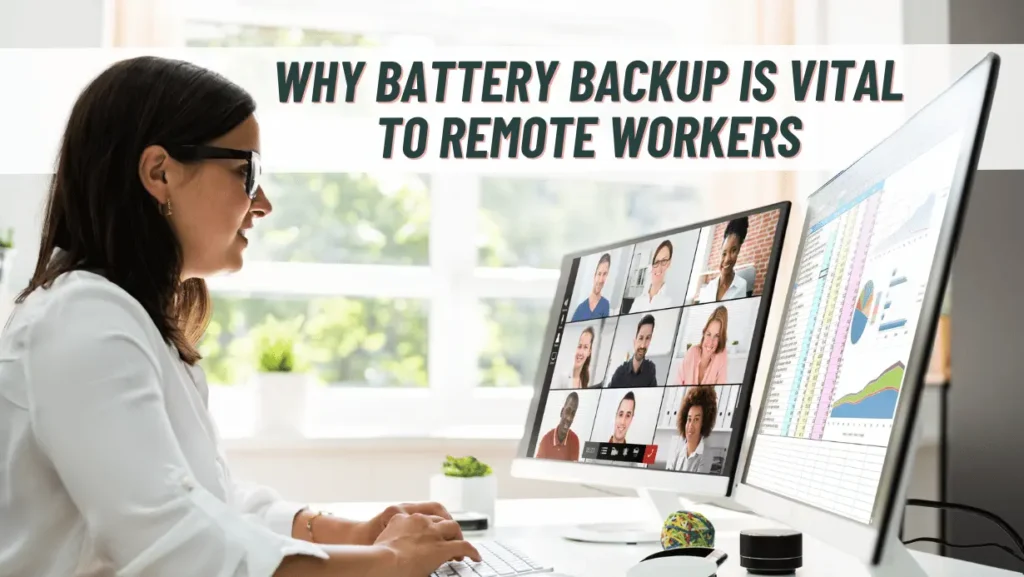
Work-from-home (WFH) culture and battery backup have changed how remote workers deal with power outages. What used to feel like a temporary household inconvenience can now interrupt meetings, pause projects, knock out internet access, and throw an entire workday off track. For remote workers, dependable electricity is no longer just about comfort. It is part of what makes it possible to stay productive, connected, and professionally reliable from home.
That is why battery backup has become such an important resource for work-from-home households. A properly designed battery system can help keep key equipment and essential parts of the home running during an outage, reducing disruption and helping you stay functional when the grid goes down. For remote workers, that can mean fewer interruptions, less stress, and more confidence that one outage will not derail the entire day or work project.
In this article, we will look at why battery backup matters for remote workers, what it can help power, how it compares to other outage workarounds, and what to think about if you are considering a system for your home.
Why Power Reliability Matters More When You Work From Home
A power outage can be frustrating for anyone, but remote workers often feel the impact more immediately and more personally. When your home doubles as your workplace or business, losing power does not just interrupt your routine. It can shut down the place where you earn a living.
For many work-from-home professionals, the issue goes beyond simply keeping a laptop charged. A remote work setup often depends on a chain of connected tools and systems all working together. Your router and modem need power. Your desktop computer, monitors, chargers, and office lighting also need consistent electricity. Even if you work from a laptop, that battery only lasts so long, and a dead internet connection can bring the day to a halt long before your device runs out.
There is also the professional side of the disruption. Employers, coworkers, and clients still expect availability, responsiveness, and reliability, even when the outage is happening at your house and not in a traditional office. A dropped video call, missed deadline, or interrupted presentation can create stress far beyond the outage itself.
Short outages can still create big problems
Even a short power outage can throw off an entire day or work project. A missed call becomes a delayed conversation. A paused task creates a bottleneck in the rest of your and your coworkers schedules. A lost hour of focused work can force you to play catch-up long after the power returns. Even a short power outage can cause files to be lost or corrupted, losing hours of hard work. For freelancers, consultants, and home-based business owners, even temporary downtime may have a direct financial impact.
That is what makes remote workers different in this conversation. A power outage is not just inconvenient. It can interfere with productivity, professionalism, and income in a very real way.
Don’t let power outages put your career, your business, or your livelihood at risk. Get your free battery backup analysis today to see how you can benefit from battery backup. Chat with our battery experts to see how much battery capacity you might need.
What Battery Backup Is and How It Helps
Battery backup systems store electricity so it can be used when your home needs it, including during a utility power outage. Batteries can store electricity from the utility grid or from solar. When the grid goes down, a properly configured battery backup system can automatically and seamlessly supply power to selected circuits or essential loads, helping your home and business stay functional instead of going completely dark.
For remote workers, that matters because battery backup can do much more than keep a few lights on. Depending on the design of the system, it can help power the devices and home systems that support your workday and the broader household around it.
A battery backup system may be used to keep your internet equipment running, support laptop and phone charging, power a desktop computer and monitors, and maintain office lighting and appliances so you can continue working more normally during an outage. Many homeowners also choose to back up other essentials such as refrigeration, key outlets, garage access, and in some cases select heating or cooling equipment depending on system size and setup.
The beauty of battery backup is that it is ready to kick in seamlessly at a moment’s notice. Once a power outages is detected, the batteries automatically provide power without any blinks, gaps, or losses. This means you don’t lose internet connection, you don’t drop calls, and your don’t lose any files and hours of work waiting for backup to kick in. And since you don’t have to worry about starting, fueling, or maintaining a generator, you have even less to worry about when staying powered in an outage.
Learn more about the pros and cons of battery backup vs. generators and see which is right for you. And to get your free battery backup analysis, contact Green Ridge Solar today!
Whole-home backup vs. essential-load backup
Not every battery backup system is intended to power an entire home, and that is important to understand. Some homeowners want whole-home backup, while others prefer to focus on essential loads only. For many remote workers, the most practical approach is to prioritize the home office and the parts of the house that need to remain functional for the day to continue smoothly. However, some households prefer to maintain more of the comforts of home during a power outage, which can also help maintain productivity and creativity while working from home.
The right design depends on your goals, your energy use, and what you want your home to be able to do when utility power is interrupted.
Contact Green Ridge Solar today to learn more about the benefits of battery backup and to get your free solar design.
READ COMPLETE GUIDE TO BATTERY BACKUP
- Myths & misconceptions
- How does battery backup work?
- How much does it cost?
- What are the benefits?
What Remote Workers Can Power with Battery Backup
One of the most important questions for any work-from-home household is simple: What do you actually need to keep running when the power goes out? The answer is different for every home, but for most remote workers, the goal is not to power everything. It is to keep the systems and devices running that allow the workday to continue with as little disruption as possible.
That is where thoughtful battery backup system design matters. Some homeowners may only want to protect a few office essentials, while others want a broader backup plan that supports both work and daily life. Understanding which loads matter most is one of the best ways to determine what kind of battery backup setup makes sense for your home.
Internet equipment
For many remote workers, internet access is the first priority. Keeping the router and modem powered can make the difference between continuing the workday and being completely disconnected.
That may sound like a small detail, but it often has an outsized impact. Even if your laptop is fully charged, your work may still come to a halt if your internet equipment loses power. Video calls, cloud-based programs, messaging platforms, email, file sharing, and VPN access all depend on a stable connection. When the modem and router go down, the rest of your setup may become far less useful.
For many work-from-home households, keeping internet equipment powered is the foundation of the entire battery backup strategy. If the connection stays live, there is a much better chance of maintaining communication, meeting deadlines, and staying available during an outage.
Computers and charging equipment
A battery backup system may be designed to support laptop charging, desktop computers, monitors, phones, and other core devices that make work possible.
This part of the backup plan matters because many remote work setups involve more than a single device. A laptop may be the centerpiece, but many professionals also rely on external monitors, docking stations, desktop towers, wireless accessories, phones, tablets, webcams, and charging equipment throughout the day. In a more tech-heavy home office, those tools are not optional extras. They are part of how work gets done efficiently and comfortably.
For remote workers who spend long hours at their desks, maintaining access to those devices can make the difference between working normally and trying to patch together a much less functional setup. Battery backup can help preserve that day-to-day workflow instead of forcing you to scale everything back the moment the power goes out.
Office lighting and basic comfort
The ability to keep lights on in the home office can make a big difference, especially during darker winter afternoons or stormy weather. In some cases, homeowners may also want to support select heating or cooling equipment, depending on the battery size and system design.
This part of the conversation is easy to overlook, but it matters more than many people expect. A home office that suddenly becomes dim, cold, hot, or generally uncomfortable can quickly stop feeling like a practical place to work. Even if your internet and devices still have power, it may be hard to stay focused, professional, or productive if the room itself is no longer usable.
That is why some homeowners think beyond electronics alone and consider what helps maintain a workable environment. Depending on priorities and budget, that may include office lighting, a few key outlets, or select comfort-related loads that help make the space feel stable and functional during an outage.
Essential household loads
For many people, working through an outage only feels realistic if the household remains functional too. Refrigeration, kitchen outlets, garage access, and other essentials may all be part of the backup plan, depending on priorities and budget.
Remote work does not happen in a vacuum. It happens in the middle of real homes with daily routines, family needs, meals to prepare, and responsibilities that continue even when the grid goes down. If the refrigerator is off, the kitchen is disrupted, the garage door will not open, or key parts of the home become difficult to use, it can be much harder to stay focused and productive at work.
That is why many homeowners choose to think about battery backup as a household support system as much as a home office solution. Protecting a few essential household loads can make the entire day feel more manageable and can help create the kind of stability that allows remote work to continue more smoothly.
Would you like to keep WFH essentials powered in an outage? Want to maintain internet access, computers & monitors functional, and productivity maximized? How about powering heating, cooling, and appliances? Then get your battery backup analysis today! Don’t wait for the next outage, chat with Green Ridge Solar’s battery experts to see how you could benefit from battery backup.
Why Battery Backup Supports More Than Just the Home Office
Work-from-home life rarely happens in isolation. It is part of a larger household rhythm that includes meals, family responsibilities, comfort, and day-to-day living.
That is an important part of the battery backup conversation. A remote worker may technically only need internet access and a computer to keep working, but in real life, productivity depends on more than a desk setup alone. It depends on whether the rest of the home can keep functioning well enough for the day to stay manageable.
When the power goes out, the effects tend to spread quickly beyond the home office. The kitchen may become harder to use. The garage door may stop working. Medical devices might stop functioning. The home may become darker, less comfortable, and more disruptive overall. In households where work, family life, and daily routines all happen under one roof, that broader disruption can make it much harder to stay focused and productive even if a few work devices still have power.
Remote work still depends on a functional household
It is much harder to stay focused on your work when the refrigerator is off, the garage will not open, medical devices stop working, or parts of the home feel dark and unusable. Battery backup can help make the entire home more workable during an outage, not just the office corner.
That matters because remote work happens inside the flow of everyday life. People still need to make lunch, manage pets, move in and out of the garage, charge phones, and keep the home operating at a basic level while they work. If several of those everyday functions suddenly become difficult, the workday can start to unravel even if your laptop still has some battery left.
Battery backup can help create a more stable environment by keeping a few essential household loads running alongside office equipment. For many homeowners, that broader support is what makes working through an outage feel realistic instead of frustrating and unsustainable.
Families may feel the benefit even more
In households with children, multiple adults working from home, or a mix of work and school schedules, one power outage can create widespread disruption. Battery backup can help keep more of the household steady while everyone navigates the interruption.
When more than one person depends on the home to function during the day, the impact of a power outage grows quickly. One parent may be trying to stay in meetings while another works from a separate room. Children may be home after school or learning remotely. Meals still need to be prepared, devices still need to be charged, and the normal demands of the household do not simply pause because the power went out.
In these situations, battery backup can help reduce the sense of household-wide chaos. Keeping key parts of the home operational can make it easier for everyone to adjust without the entire day falling apart. That stability can be especially valuable for parents and caregivers who are trying to balance professional responsibilities with everything else happening at home.
Comfort matters for productivity too
A home office that becomes too cold, too hot, or too dark can quickly stop being a practical place to work. Depending on the system design, battery backup may help preserve a more usable environment.
Comfort may sound secondary compared to internet or computer power, but it has a real effect on whether someone can continue working effectively. A dim room can make tasks harder to do. A house that becomes too cold in winter or too warm in summer can turn focused work into a struggle. Even if the outage is short, discomfort can make it harder to think clearly, stay patient, and maintain a professional presence on calls.
That is why some homeowners think carefully about how battery backup can support not just devices, but the overall livability of the home during an outage. Depending on the system size and priorities, preserving lighting and select comfort-related loads can help keep the home office usable and the workday far more manageable.
Want to keep heating and cooling on during power outages? How about essential appliances? Then request your free battery backup analysis today! See how many batteries you might need and how long you could stay powered in an outage. Contact Green Ridge Solar today for your battery quote.
Real-World Scenarios Where Battery Backup Can Make a Difference
The benefits of battery backup become easier to understand when you picture real situations. For many remote workers, the value of backup power does not become fully clear until they imagine what an outage would actually interrupt in the middle of a normal day.
That is because power loss rarely happens at a convenient time. It tends to show up in the middle of a meeting, a deadline, a busy afternoon, or a day when the whole household is already juggling multiple responsibilities. Looking at a few realistic scenarios can help show why battery backup matters not just in theory, but in the day-to-day reality of working from home.
The important video call
You are in the middle of a client presentation or team meeting when the power goes out. Without backup, the call drops and your internet disappears. With battery backup supporting your office essentials, you may be able to finish the conversation without interruption.
This kind of moment can feel minor on paper, but it often carries bigger consequences in real life. A dropped call can interrupt the flow of a presentation, make a poor impression during a first meeting, or force you to scramble to reconnect while everyone else waits. If the conversation is time-sensitive or high-stakes, you may not get the same opportunity back in quite the same way.
Battery backup can help protect against that kind of abrupt disruption by keeping the core parts of your setup running long enough to stay present, communicate clearly, and finish what you started. For remote workers who spend a large part of the day on video calls, that continuity can make a meaningful difference.
The deadline-driven freelancer
You are working toward a hard deadline and a multi-hour outage hits in the middle of the day. That is not just frustrating. It can affect deliverables, revenue, and client relationships. Backup power can help keep your work moving.
Freelancers, consultants, and self-employed professionals often feel outages differently because their time is directly tied to output and income. If the power goes out during a crucial work block, it may not just delay a project. It can create stress around missed expectations, delayed invoicing, or clients wondering why the work suddenly stopped.
Battery backup can help create more breathing room in these situations. Instead of losing the entire afternoon or work day, you may be able to keep writing, designing, editing, meeting, or communicating long enough to stay on track. For people whose livelihood depends on consistent productivity, that added continuity can be incredibly valuable.
The two-remote-worker household
In homes where more than one person works remotely, an outage can affect two jobs at once. Battery backup can help preserve continuity for multiple people instead of leaving the whole household offline.
This is becoming more common as more couples and shared households rely on home offices at the same time. One person may be in meetings all afternoon while the other is trying to meet a deadline, support clients, or stay available online. When the power goes out, the disruption does not just affect one desk. It can disrupt the rhythm of the entire household.
Battery backup can help reduce that shared disruption by keeping critical loads available for more than one person. Even if the system is designed around essential loads rather than whole-home backup, preserving internet access, office equipment, and a few important household functions can make the situation much easier to manage for everyone involved.
The rural or outage-prone homeowner
For homeowners in rural areas or regions with more frequent outages, battery backup can be especially valuable. When outages are not rare, planning for them becomes much more practical.
In some areas, outages are not unusual interruptions. They are part of life. Whether the cause is storms, wind events, wildfires, aging infrastructure, or longer utility restoration times, remote workers in these locations may face repeated and extended disruptions if they do not have a plan in place.
For those homeowners, battery backup can offer more than convenience. It can create a greater sense of consistency and control in an environment where grid reliability may be less predictable. Instead of treating each outage like an unexpected emergency, battery backup can help turn it into a manageable event that causes far less disruption to work and daily life.
Why Common Workarounds Often Are Not Enough
Most remote workers already have a few informal backup plans for when power outages strike. The problem is that many of those backup plans are limited, inconsistent, or stressful to rely on.
In theory, a workaround can sound good enough. Maybe you can leave the house, use a temporary backup device, or power a few things manually until utility power returns. In practice, those options often create new complications of their own. They may help in a narrow situation, but they are not always designed to support the full reality of working from home through an outage.
That is one of the biggest differences between improvised backup options and a dedicated home battery backup system. A workaround may help you react. A battery backup system is designed to help your home respond automatically and keep essential parts of your day functioning with less disruption.
Leaving home is inconvenient and not always realistic
Packing up and heading to a coffee shop or coworking space during a power outage may sound manageable, but it is rarely seamless. Travel takes time. Privacy may be limited. Weather may be poor. And if the outage is widespread, those backup locations may not be practical either.
For some kinds of work, leaving home is not just inconvenient. It can be a poor substitute for your actual setup. You may need multiple monitors, a private space for client conversations, access to files or equipment, or a quiet environment where you can concentrate. Recreating that on short notice in a public place is often far harder than it sounds.
There is also the reality that relocating does not just interrupt your work. It interrupts the rest of your household too. If children are home, pets need attention, weather is bad, or the outage affects a wider area, picking up and leaving may not be a practical solution at all. What seems like a backup plan in theory can quickly become another source of stress.
Relying on your cell phone is usually not enough
It can be tempting to think a charged cell phone is all you really need during a power outage. But for most remote workers, a phone is not a realistic substitute for a full work setup.
Some tasks are simply too difficult to do well from a phone. Writing longer emails, working in spreadsheets, joining detailed video calls, accessing shared files, switching between apps, managing multiple conversations, or reviewing complex documents can all become slower and more frustrating on a small screen. Even if you can technically keep working, the experience is often much less efficient and much harder to sustain for hours.
There is also the issue of network reliability. In some outages, cell service may become spotty, overloaded, or less dependable, especially if many people in the area are trying to rely on mobile data at the same time. And even when the signal is strong, data limits or slower speeds can make it difficult to support video meetings, file transfers, or other bandwidth-heavy work.
A phone can be helpful in a pinch for basic communication, but it is rarely enough to replace the combination of internet access, devices, workspace functionality, and consistency that most work-from-home professionals actually need.
Battery banks and portable power stations have limitations
Battery banks and portable power stations can be useful for charging small devices or temporarily powering select electronics, but they are not the same as a dedicated home battery backup system.
These products can absolutely have a place in an emergency kit, especially for phones, tablets, or light-duty electronics. But for remote workers, the challenge is usually not just keeping one device alive. It is keeping the right combination of devices and household functions running long enough for the workday to continue in a realistic way.
A battery bank may charge your phone or laptop, but it is not designed to support a broader home backup strategy. A portable power station may offer more capacity, but it still tends to be a manual, limited solution that requires setup, prioritization, and careful load management. In many cases, these devices are better viewed as temporary stopgaps than true work-from-home continuity solutions. In most situations, a whole-home battery backup system is the best option to keeping remote work powered in outages.
A UPS can bridge brief interruptions, but not replace home backup
An uninterruptible power supply, or UPS, can be helpful for protecting electronics from sudden shutdowns and giving you a short window to save work or ride through a very brief interruption. But it is not the same thing as home battery backup.
A UPS is typically designed for short-duration support at the device level, not for powering a meaningful portion of your home during an outage. It may keep a desktop computer or router running for a limited period, but it usually does not provide the broader capacity, flexibility, or duration needed to support an entire work-from-home routine.
For remote workers, that distinction matters. A UPS can be useful as part of a larger strategy, especially for protecting sensitive equipment and preventing abrupt shutdowns. But by itself, it is rarely enough to keep the workday running normally if the outage lasts beyond a brief moment.
Generators come with tradeoffs
Gas and diesel enerators can provide backup power, but they are often noisier, more manual, and more dependent on fuel and maintenance. Battery backup systems are typically quieter and can offer a more automatic, integrated homeowner experience.
For some homeowners, generators may still play a role in an outage plan. But they often require more hands-on involvement than people expect. Fuel availability, startup procedures, maintenance, noise, and placement all become part of the equation. That can be manageable in some situations, but it is not always ideal for someone trying to move seamlessly through a workday.
By contrast, a dedicated battery backup system is typically designed to feel more integrated into daily life. Instead of pulling generator equipment out, managing fuel, or dealing with a louder and more manual solution, homeowners can often rely on a quieter battery backup system that responds automatically and supports the essential loads they care about most.
Why dedicated battery backup stands apart
What all of these workarounds have in common is that they usually ask the homeowner to adapt to the outage. A properly designed home battery backup system does more to help the home adapt for you.
That is what makes it so valuable for remote workers. Instead of piecing together temporary fixes, relocating your workday, or managing a collection of stopgap tools, battery backup offers a more cohesive solution built around continuity. It is not just about having power somewhere. It is about having the right power, in the right places, in a way that helps your work and household function more smoothly when the grid is down.
Want battery backup for your home office or WFH setup? Contact Green Ridge Solar today for your free battery analysis!

Battery Backup vs. Generator
Learn more about the pros and cons of battery backup vs. generators. Which is right for you? Find out in our in-depth article.
Read More
Solar Plus Battery Backup: Even More Control Over Your Power
Battery backup is useful on its own, but pairing it with solar can offer even greater benefits.
Solar panels generate electricity during the day, and in the right setup, that energy can help charge your battery so stored power is available when you need it. In certain cases, solar can also charge battery backup while in use, providing extended backup power. Together, solar and battery backup can give homeowners more control over how they produce, store, and use electricity.
For remote workers, that added control can translate into greater confidence and productivity. Instead of relying entirely on the grid, you have a system designed to help support your home and your workflow even when utility power is interrupted. Depending on your setup, solar plus battery backup can also support longer-term goals around energy independence, resilience, and managing electricity more strategically.
Get your solar + battery backup analysis today! See how pairing solar energy with battery backup can power your WFH setup and support your remote work. Contact Green Ridge Solar now for you free quote!
How Green Ridge Solar Can Help
Learning about battery backup is one thing. Figuring out what makes sense for your battery backup needs is another. That is where Green Ridge Solar can help.
We take a practical, personalized approach to battery backup based on how you use electricity, what you want to keep running during an outage, and how your work-from-home setup and household function day to day.
Free battery backup analysis and quote: A free battery backup analysis and quote is a simple way to explore your options. We can help you think through what loads you may want to back up, whether you are focused on your home office or broader household support, and what kind of solution may be the best fit.
Answers to your battery backup questions: If you are wondering how much backup you need, what battery backup can power, or whether solar should be part of the plan, Green Ridge Solar can help answer those questions. Our team can walk you through the options and help you understand what makes the most sense for your home.
A local team that can help you plan with confidence: Battery backup is not one-size-fits-all, especially for remote workers. Green Ridge Solar can help you evaluate your options, answer your questions, and design a solution that fits the way you live and work.
Contact Green Ridge Solar today for you battery analysis. Our battery experts can analyze your energy needs and design a battery backup system customized for your home or business. Get your battery analysis today!
Your Work Depends on Reliable Power, Your Home Should Too
Remote work has changed the role electricity plays in daily life. For many households, power is no longer just about comfort and convenience. It is part of the foundation that supports productivity, communication, and the ability to earn a living from home.
Battery backup can help remote workers stay connected, protect their workflow, and reduce the stress that comes with unexpected power outages. Whether you work from home full-time, run a business from your house, or simply want more confidence that your day will not unravel when the grid goes down, battery backup can be a smart solution to explore.
At Green Ridge Solar, we help homeowners think through backup power in a practical, personalized way. If you are curious about whether battery backup makes sense for your home office, household, and energy goals, our team is here to help you evaluate your options and design a system that fits the way you live and work.
Want to learn more about battery backup for your work-from-home lifestyle? Contact Green Ridge Solar to start the conversation.
