
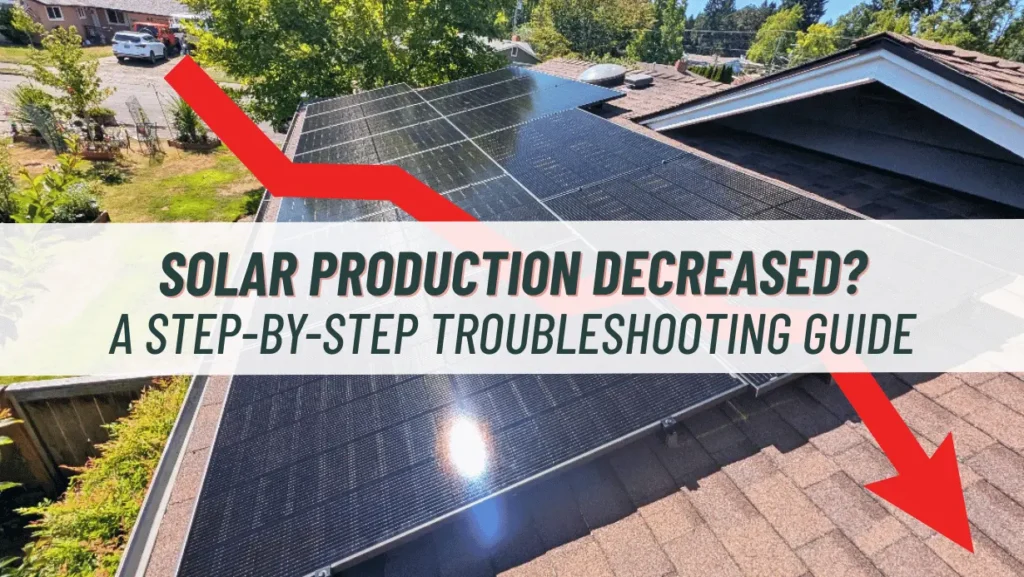
If your solar system is not producing like it used to, it can be frustrating and a little alarming. Maybe your monitoring app is showing lower production than normal. Maybe your electric bill suddenly jumped. Or maybe you have a feeling something is off, but you are not sure whether it is a serious problem or just a temporary dip.
The good news is that lower solar production does not always mean your system has a major issue. In some cases, the cause is seasonal, temporary, or relatively simple. In other cases, it may point to an equipment problem, communication issue, or maintenance need that should be addressed sooner rather than later.
This guide walks you through a practical step-by-step triage process to help you understand what might be going on, what you can safely check yourself, and when it is time to call in a solar service professional.
In This Article:
- Confirm Production has Dropped
- Step 1: Start with Obvious
- Step 2: Check for Alerts, Error Messages, or Offline Monitoring
- Step 3: Check the Simplest Equipment Issues
- Step 4: Consider Problems That Build Slowly Over Time
- Step 5: Know When It Is Time to Call a Solar Service Professional
- What Not to Do
- How Green Ridge Solar Helps Diagnose Underperforming Solar Systems
First, Confirm That Production Has Actually Dropped
Before assuming something is wrong, it is important to make sure you are looking at your system’s performance in the right context. Solar production naturally changes throughout the year, and not every dip is a sign of a malfunction.
Compare Year-Over-Year, Not Just Month-to-Month
One of the most common mistakes homeowners make is comparing one recent month to the month before it. Solar production is naturally higher in the summer and lower in the winter, so month-to-month comparisons do not always tell you much.
A better way to evaluate your solar energy production is to compare the same month this year to the same month last year. That gives you a more accurate view of whether your solar production has truly declined or whether you are simply seeing normal seasonal variation.
Review Your Monitoring Data Carefully
Your solar monitoring app or software can often tell an important part of the story. Look for a steady decline in solar energy production over time, a sharp and sudden drop, or missing production data altogether. A sudden drop may suggest an equipment or electrical issue, while a gradual decline may point to shading, buildup on the panels, or aging system components.
It is also important to remember that monitoring issues and production issues are not always the same thing. Sometimes a system is still producing, but the monitoring connection has gone offline and is no longer reporting correctly.
Think About Recent Weather and Conditions
Weather can temporarily affect solar production more than many homeowners realize. Heavy cloud cover, wildfire smoke, ash, snow, pollen, and debris can all impact output. If your area has had unusual weather conditions lately, that may explain at least part of the drop.
That does not mean you should ignore lower production, but it does mean you should take a moment to rule out temporary external factors before assuming something inside the system has failed.
Step 1: Start With the Obvious
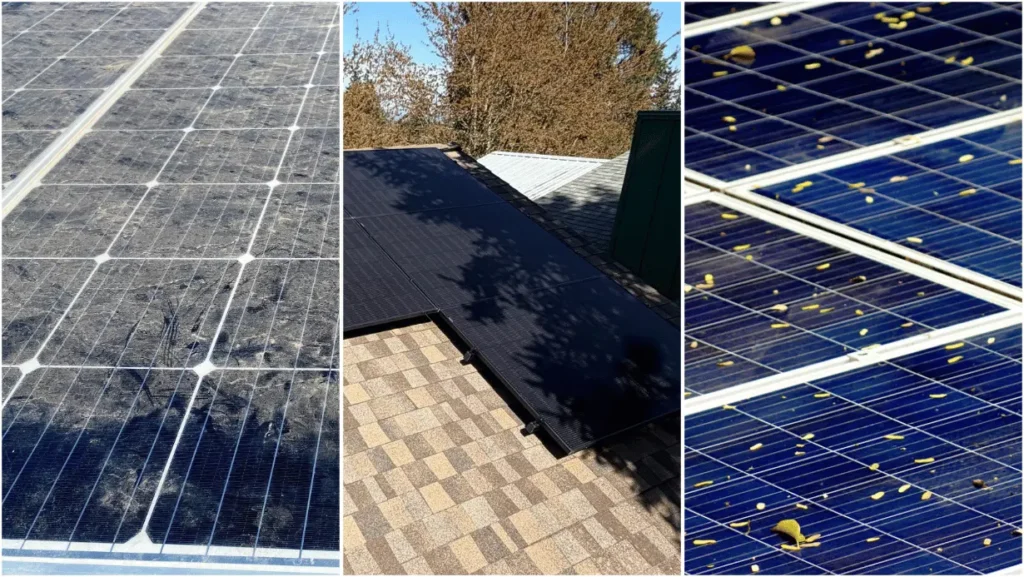
The first step in triaging lower solar production is a simple visual check from the ground. Before you assume there is a major equipment failure, it is worth taking a few minutes to look for obvious surface-level issues that may be affecting performance. In many cases, homeowners can identify early clues just by observing the array, the surrounding area, and any visible buildup or obstructions. You do not need to climb onto the roof or open any equipment to spot a few common issues, and you should not put yourself at risk trying to investigate beyond a safe visual inspection.
Are the Panels Dirty?
Solar panels do not need constant cleaning, but they can lose efficiency when dirt, dust, pollen, bird droppings, wildfire ash, or other buildup starts to accumulate. This can happen gradually, which is why some homeowners do not notice a problem until production has been reduced for quite a while.
In many cases, light dust or normal grime will not create a dramatic loss in solar energy output. But heavier buildup absolutely can. If your panels look especially dirty or have visible debris covering portions of the array, that could be contributing to the issue.
While a quick rinse with a hose can often clear most of the debris off solar panels, it might not always be enough. Cleaning your solar panels on your own is possible, but must be done with extreme caution. Read more about cleaning your solar panels on our website.
If you believe your solar panels need cleaning, it’s often best to contact a solar service professional. This will ensure you are keeping your health and safety in mind, while also ensuring your solar panels receive the best care.
Contact Green Ridge Solar today for professional solar cleaning services, and to ensure your solar panels are at peak production and savings. And check out our Continuing Care Plan to get free annual solar panel cleanings PLUS many other perks. Check it out!
Has Shade Increased Over Time?
Shade is another common cause of reduced solar performance. Trees grow. Landscaping changes. Nearby additions, structures, or roof features may begin casting shade where they did not before. Even partial shading can affect solar production, especially depending on how your system is designed.
If your solar panel system used to receive strong sun exposure and now has new shadows during key hours of the day, that change may be worth investigating. This could include trimming trees or readjusting obstructions that are shading your solar panels and reducing energy output.
Is There Leaves, Snow, or Debris Blocking Sunlight?
Seasonal debris can also reduce solar output. Leaves, pine needles, branches, and snow accumulation can block sunlight from reaching the panels. Sometimes the problem is as simple as the array being partially covered after a storm or seasonal buildup.
Only inspect your solar panels from a safe vantage point. Do not climb on your roof or attempt to remove debris in a way that puts you or your system at risk. In the winter, snow and ice can be removed from ground-mounted solar panels with little risk to health. However, it is not advisable to clean snow or ice off of rooftop solar panels, as this can post serious health and safety risks. Read more about cleaning snow and ice off solar panels in our detailed article.
Enroll in Continuing Care Plan
Protect your solar investment and solar savings with the Continuing Care Plan. Members get access to free annual cleanings, free annual site visit ($295 value), free inspection reports, system monitoring, special discounts, AND MORE!
Step 2: Check for Alerts, Error Messages, or Offline Monitoring
If a visual inspection does not help explain lower solar energy production, the next step is to check your system’s digital clues. This is often where homeowners can start narrowing down whether the issue is related to solar energy production itself, a communication problem, or an equipment fault. Your inverter, battery system, and monitoring platform may all provide useful information that can help point you in the right direction before you move on to more technical troubleshooting or professional service.
Look for Inverter, Battery, or Monitoring Alerts
Your inverter, battery system, or monitoring app may be telling you more than you realize. Look for warning lights, fault codes, app notifications, or error messages. These alerts can sometimes point directly to the problem, whether it is an inverter fault, communication issue, or something else affecting performance.
If you see an unfamiliar code or error, make a note of it. Even if you do not understand what it means, it can be very helpful information for a service technician. Once you have those details, contact your solar company and explain your situation so they can troubleshoot the issue and correct it if necessary.
If you are experiencing inverter, battery backup, or monitoring errors, contact Green Ridge Solar. Their solar and battery experts can diagnose and troubleshoot your issues, even if they didn’t install your system. Contact Green Ridge Solar’s in-house service team today!
Determine Whether It Is a Production Problem or a Communication Problem
Sometimes the solar panel system itself is still operating, but the monitoring has stopped reporting. This can happen because of Wi-Fi issues, router changes, internet disruptions, or problems with a monitoring gateway.
If your app says the system is offline, it does not automatically mean the solar equipment has stopped producing. However, monitoring issues still matter. If you cannot see what your system is doing, it becomes much harder to catch real problems early.
If you experience communication issues with your solar panel system, contact your solar company. They can assist in diagnosing and troubleshooting the issue. You can also contact Green Ridge Solar, who’s in-house service team can diagnose and resolve your communication issues, even if they didn’t install your system. Contact Green Ridge Solar today to resolve your solar communication issues.
Think About Recent Power Outages or Electrical Events
Has your home recently experienced a power outage, breaker trip, or electrical disturbance? In some cases, a solar system may not restart or reconnect properly after an outage or grid event. That can leave the system underperforming or completely offline.
If your production problems started shortly after an outage or electrical issue, that timing could be an important clue. To fully diagnose and troubleshoot solar and battery issues after a power outage, contact your solar company.
Step 3: Check the Simplest Equipment Issues
This step is still about basic triage, not repair. At this point, you are simply trying to determine whether there are any clear signs that the solar panel system has partially or fully shut down, or whether a basic equipment issue may be contributing to lower production. The goal is not to diagnose every possible technical problem on your own, but to look for obvious indications that the system is not operating normally and gather helpful clues before deciding whether professional service is needed.
Check the Breakers
A tripped breaker may be part of the problem. If you are comfortable doing so, check whether the solar breaker or related breaker appears to have tripped. Sometimes this is an isolated issue. Other times, repeated trips may point to a deeper problem that needs professional diagnosis.
If you are unsure what you are looking at, or if anything seems unusual, stop there and call a professional. Solar electrical equipment is not something to guess your way through and can be hazardous if not operated properly.
If you are having issues with tripped solar breakers, contact Green Ridge Solar. Their in-house service experts can troubleshoot why your breakers are tripping and resolve the issue.
Check Whether the Inverter Appears to Be Operating Normally
Many solar inverters provide basic status information through indicator lights, screen messages, or display panels. If the inverter appears to be off, faulted, or showing a warning state during sunny daytime hours, that could explain why solar production is down.
Different solar equipment brands display information differently, so you may need to consult your manual or service provider if the status is unclear.
For assistance decoding and troubleshooting inverter errors or warning, contact Green Ridge Solar. Their solar experts have experience with a wide array of inverter brands and can resolve your issues quickly.
Look for Signs the System Is Fully Offline
If your solar monitoring shows no production at all during sunny hours, the inverter appears to be shut down, and your electric bill has increased unexpectedly, there is a good chance the system is not operating normally. That is usually the point where professional troubleshooting becomes the smartest next step.
Contact Green Ridge Solar today for all your solar production issues. Their in-house service team can get your system back up and running in no time, even if they didn’t install your system.
Step 4: Consider Problems That Build Slowly Over Time
Not every solar problem happens all at once. Some issues develop gradually and quietly reduce performance month after month, which can make them harder to spot right away. In these cases, homeowners may not notice a problem until electric bills start creeping up, monitoring data shows a longer-term decline, or the system is no longer delivering the savings it once did.
Soiling and Lack of Maintenance
Over time, dirt and dust buildup can slowly chip away at solar production. In some cases, the effect is small. In others, especially when combined with pollen, debris, bird droppings, or environmental exposure, the losses can become more noticeable.
Routine maintenance and system checkups can help catch these issues before they create larger performance losses and cost you valuable energy savings.
If it’s been awhile since you’ve checked your solar panels or had them cleaned, now is a good time to check. If you are unsure if your solar panels need cleaning, speak with your solar company or consult our webpage about cleaning solar panels.
You can also contact Green Ridge Solar, who offers solar panel cleaning services. To check availability and pricing, contact Green Ridge Solar today!
Aging Components or Equipment Wear
Like any home energy system, solar equipment can develop issues as it ages. Inverters, optimizers, microinverters, disconnects, wiring, and connections can all experience wear or failure over time. Sometimes only one part of the system is affected, which can make the drop in production less obvious at first.
A professional inspection can help determine whether the issue is isolated to one component or part of a larger system problem. Once those issues are resolved, your solar production should be restored and save you even more on energy bills.
For a solar inspection and to determine if equipment maintenance is needed, contact your solar company. You can also contact Green Ridge Solar, who provides a detailed solar inspection whether you installed with them or not. Contact Green Ridge Solar today to inspect your solar system and equipment.
Property and Roof Changes
Changes to your property can also affect solar performance over time. Trees may have matured. Roof work may have disturbed part of the array or surrounding components. Nearby construction may have introduced new shade or environmental conditions.
Even if the system itself has not changed, the environment around it might have. If you are unsure whether property or structural changes have affected your solar production, contact your solar company. They can do a full assessment and determine if any actions can or should be taken to restore solar production.
Step 5: Know When It Is Time to Call a Solar Service Professional
At a certain point, further guessing does not save time or money. If your system is clearly underperforming and the cause is not obvious, professional diagnosis is usually the fastest path to answers. Rather than continuing to wonder whether the issue is minor, temporary, or something more serious, a qualified solar service professional can help pinpoint the cause and recommend the right next steps. In many cases, getting clear answers sooner can help prevent additional lost production, higher utility bills, and more frustration over a system that is not performing the way it should.
Signs You Should Schedule Service
It is a good idea to call a solar service professional if:
- your production has dropped suddenly and you cannot explain why
- your inverter or battery system is showing errors or warning lights
- your system has gone offline for an extended period
- your breaker keeps tripping
- your electric bill has jumped without a clear reason
- your monitoring is not working and you are not sure whether the system is still producing
- you suspect a component has failed or part of the system is no longer operating correctly
Why Professional Diagnosis Matters
The reason solar service matters is simple: not every issue is visible from the ground or obvious in an app. A trained solar technician can evaluate whether the problem involves the inverter, monitoring system, electrical components, wiring, shading, panel-level electronics, or something else entirely.
The longer an underperforming system goes unchecked, the more production and savings you may lose. What starts as a small issue can turn into months of reduced performance if nobody identifies it.
What If Your Original Installer Is Gone or Not Responding?
Unfortunately, some homeowners discover a production problem only to realize their original installer is no longer around, no longer services the system, or simply will not call them back. That leaves a lot of solar owners feeling stuck.
The good news is that you may still have options. A qualified local solar service company may be able to inspect, troubleshoot, and repair your system even if they did not install it in the first place.
For solar and battery backup owners in Oregon and Washington, Green Ridge Solar is here to help! Green Ridge Solar services and maintains solar and battery backup systems even if they didn’t install them. They have helped many solar and battery customers who were abandoned by their original solar company. Contact Green Ridge Solar today for all your solar and battery backup service and maintenance needs.
What Not to Do
When your solar panels are underperforming, it can be tempting to start trying anything you can think of, especially if you are worried about lost savings, rising electric bills, or a system that seems to be offline. But when solar equipment is involved, not every troubleshooting step is safe for homeowners to take on themselves. Some actions can put your health and safety at risk, while others can lead to accidental damage to your roof, solar panels, or electrical equipment. That is why it is important to know the difference between safe basic triage and steps that should always be left to a trained solar service professional.
Do Not Climb on the Roof
Getting on the roof to inspect or clean your own solar panels can be dangerous, especially if the roof is steep, wet, slippery, or obstructed. Even a simple visual check can quickly become a fall risk, and trying to clean around panels or racking adds another layer of hazard. It also creates the risk of damaging the roof, the racking, or the panels themselves, which can lead to costly repairs on top of the original production issue.
Protect your safety and the integrity of your solar panel system. Contact your solar company if you believe your rooftop solar panels need service or maintenance.
Do Not Open Electrical Equipment
Solar systems involve live electrical components that can be dangerous even when parts of the system appear inactive. Because solar equipment can continue carrying voltage under certain conditions, it is not always safe to assume something is harmless just because it looks shut down or is not actively producing at the moment. Opening disconnects, wiring compartments, or equipment panels without the proper training can expose you to serious electrical hazards and may also create additional equipment issues.
Unless you are properly trained and qualified to work on solar electrical systems, it is best to leave those steps to a licensed professional. Before opening electrical panels or touching wiring, contact your solar company for proper guidance and service.
Do Not Ignore the Problem
A solar system that is not producing normally is not just an inconvenience. It is also lost energy production, lost financial value, and potentially a sign that a small issue is turning into a larger one. The longer a problem goes unaddressed, the more savings you may miss out on, and the more difficult it can become to understand when the issue first started. If something feels off, it is worth taking seriously and investigating sooner rather than later.
Enroll in Continuing Care Plan
Protect your solar investment and solar savings with the Continuing Care Plan. Members get access to free annual cleanings, free annual site visit ($295 value), free inspection reports, system monitoring, special discounts, AND MORE!
How Green Ridge Solar Helps Diagnose Underperforming Solar Systems
At Green Ridge Solar, we help homeowners figure out why their solar panels are underperforming and what needs to happen next. That includes both customers we originally installed for and customers who were installed by someone else.
Our team can help with solar service and troubleshooting, including system inspections, production checks, monitoring and communication troubleshooting, equipment diagnostics, and many common repair needs. If your solar panel system is not producing like it used to, we can help you get clarity on what is happening and what your options are.
That is especially important for orphaned solar customers who feel like they have nowhere to turn. If your original solar installer or solar company has gone out of business, stopped responding, or is no longer providing support, you should not have to guess your way through a production problem on your own. Contact Green Ridge Solar today for all you solar service needs.
Get Help If Your Solar System Is Underperforming
If your solar system is not producing like it used to, don’t panic, but definitely don’t ignore it either. Sometimes the cause is simple. Sometimes it is not. Either way, a step-by-step triage approach can help you rule out common issues, recognize warning signs, and know when it is time to bring in an expert.
If you are dealing with lower solar production, monitoring problems, inverter errors, or a system that just does not seem to be performing like it should, Green Ridge Solar is here to help. Contact our team to schedule service, get answers, and take the next step toward getting your system back on track.
Contact Green Ridge Solar today for all your solar and battery backup service needs, even if we didn’t install your system originally.
