
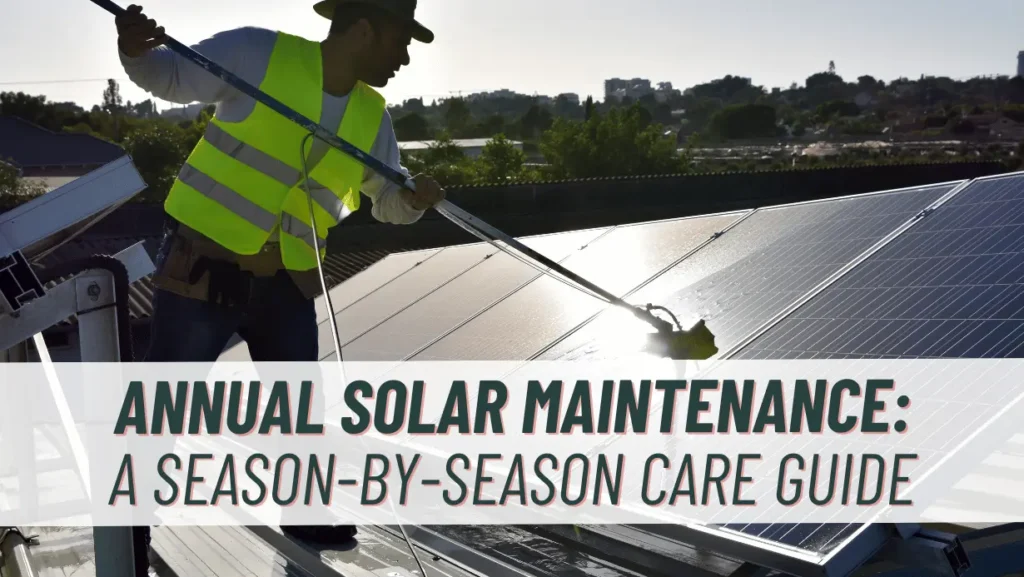
Solar energy is quiet, dependable, and requires very little maintenance. But in Oregon, our seasons bring very specific conditions that can influence production and long-term system health: weeks of rain, spring pollen, coastal salt air, farm dust, wildfire smoke, windstorms, and the occasional snow or ice event.
The good news is you don’t need a complicated maintenance regimen. You need a seasonal rhythm – a few smart habits that help you spot the rare issues early, protect your equipment, and keep your system performing the way it was designed to.
This guide uses the same structure for each season so it’s easy to scan and revisit. You’ll also see Oregon-specific special sections (snow/ice, smoke season, coastal conditions, storm readiness, and battery backup) that you can jump to when those conditions show up.
Safety note: Avoid roof work and electrical enclosures unless you’re trained and equipped for it. Most smart solar care can be done through monitoring plus ground-level observation, and anything beyond that is best handled by a professional solar service team.
In This Article:
- All-Year Habits That Make Seasonal Care Easy
- Spring Solar Maintenance in Oregon (March-May)
- Summer Solar Maintenance in Oregon (June-August)
- Fall Solar Maintenance in Oregon (September-November)
- Winter Solar Maintenance in Oregon (December-February)
Need your solar panels repaired, removed, or replaced?
Having solar production issues? Inverter errors? Monitoring app stop working?
We can help! We offer a wide array of solar & battery services, whether you installed solar with us or not:
All-Year Habits That Make Seasonal Care Easy
Before we go season by season, here are the simplest solar maintenance habits that make everything else easier. If you build these into your routine, seasonal solar care becomes less stressful and more catches potential issues earlier.
Start in your solar monitoring app. You’re not looking for perfection, you’re looking for consistency. If you know how your system typically performs on a sunny day, you’ll feel much more confident when cloudy weeks roll through. After that, do a quick scan of your solar panels from the ground. You’re checking for changes: new shade, debris, anything shifted after wind, or signs of animal activity. If you ever see a major drop that doesn’t match the weather, the best next step is to reach out for service rather than guessing.
- Check your monitoring app for consistency (reporting, trends, sudden dips).
- Compare output to the weather (sunny-day drops matter more than storm-week dips).
- Do a ground-level visual scan for new shade, debris, or anything that looks shifted.
- Reach out for service if you see persistent errors, missing data, or a sudden drop that doesn’t recover.
Contact Green Ridge Solar’s service team for any questions about solar maintenance and repair. Their solar and battery experts can diagnose, troubleshoot, and repair issues with your solar panels, battery backup, inverter, and more. Contact Green Ridge Solar today!
Spring Solar Maintenance in Oregon (March–May)
Spring in Oregon is a season of transition. Longer days and brighter skies bring solar production back up, but the environment gets busy too. Pollen can coat panels, branches can grow and create new shade, and spring storms can test roofs and electrical equipment. Spring is also one of the best times to confirm your system is ready for the higher-production months ahead.
What’s normal in spring
In spring, it’s normal for solar production to climb overall while still feeling inconsistent week-to-week. Oregon weather can swing from sunny days to rainy stretches quickly, and those shifts show up clearly in your solar monitoring app. In many areas (especially the Willamette Valley or tree-heavy neighborhoods) you may also see pollen leave a light film on solar panels. Often, a couple good rains take care of pollen and debris, but it could be a good idea to a professional team come and clean your solar panels. Learn more about cleaning your solar panels, and contact Green Ridge Solar today for solar panel cleaning service.
- Solar production should trend upward overall even if daily output fluctuates.
- Weather-driven swings are common (sunny days vs. rainy stretches).
- Pollen and debris film may appear; rain often helps, but not always immediately.
What to prioritize & watch for
Spring is the time to pay attention to the factors that quietly reduce output before summer arrives. New shading is a big factor to look out for. Branches and vegetation can grow fast enough to create meaningful shade on your solar panels by mid-summer. It’s also when critters begin nesting under solar arrays, and when winter debris can show up as stubborn accumulation along array edges or in roof valleys. Your goal for spring is to prevent a small, avoidable issue from becoming a peak-season headache.
- Watch for new shading from spring growth.
- Look for early critter activity or nesting under the array.
- Check for debris buildup after spring winds.
- Pay attention to pollen and dust conditions.
What’s worth acting on
A healthy spring solar panel system usually shows steady improvement as daylight increases. What’s worth acting on is anything that breaks that pattern, especially a sudden production drop on sunny days that doesn’t rebound. Repeated inverter errors, missing monitoring data, or visible storm impacts also deserve attention sooner rather than later. Spring is also a good time to act on roof-health signals like consistent gutter overflow or water issues, because roof integrity and solar reliability go hand in hand.
What to watch for:
- A sudden sunny-day drop that persists beyond a few clear days.
- Repeated errors or monitoring that stops reporting.
- Clear shade changes that are measurably reducing output.
- Roof drainage concerns (overflow, pooling, or suspected leak symptoms).
A simple spring routine
Choose one clear week and treat it as your spring “baseline reset.” Look at your solar monitoring on a couple sunny days and note typical production. Then walk your property and observe shade patterns (morning and late afternoon are most revealing). After a spring wind event, do a quick ground-level debris check around the array. Finally, if you suspect pollen buildup, watch for production recovery after rain. If solar output remains unusually low, professional cleaning may be worth considering.
- Reset your baseline using one clear spring week.
- Audit shade patterns (especially morning/late afternoon).
- Do a post-wind debris scan from the ground.
- Track pollen recovery after rain; consider service if performance stays lower than normal.
Spring storms & why battery backup matters
Oregon spring storms can bring power outages, voltage fluctuations, and wind-driven rain that can result in downed limbs or stressed utility lines. If you have battery backup, spring is often when you appreciate it quietly: Your essentials stay on, your internet stays up, and you don’t lose work or food to a power outage.
But if you don’t have battery backup, spring is a good time to consider the many benefits of battery backup and resilience. If your household relies on remote work, medical devices, or well pumps, spring is an ideal time to evaluate whether battery backup would meaningfully reduce your risk and help protect your home and family.
Learn more about battery backup in The Complete Guide to Battery Backup. And to get your battery backup quote, contact Green Ridge Solar today!
Beware of pollen season
Pollen in Oregon isn’t just an allergy issue, it can be a solar performance issue as well. During peak pollen weeks, solar panels can develop a light film that reduces sunlight transmission. Often, a few good rains clear it. But if pollen combines with dust (common in rural areas) it can stick longer. If you notice production staying lower than expected even after clear days return, professional cleaning may be worthwhile, especially if your array sits near heavy tree cover.
Learn more about cleaning your solar panels, and contact Green Ridge Solar today for solar panel cleaning service.
Need your solar panels repaired, removed, or replaced?
Having solar production issues? Inverter errors? Monitoring app stop working?
We can help! We offer a wide array of solar & battery services, whether you installed solar with us or not:
Summer Solar Maintenance in Oregon (June–August)
Summer is when your solar panel system has its biggest opportunity to produce energy, which makes it the season where it’s most valuable to catch issues early. It’s also when Oregon’s environment can throw a few curveballs: dry-season farm dust, wildfire smoke, and higher outage risk during extreme weather events.
What’s normal in summer
In summer, you should see your most consistent solar production during clear stretches, with dips when marine layer mornings roll in, haze appears, or smoke reduces sunlight. It’s also normal for panels to run slightly less efficiently on extremely hot days (solar loves sunlight, but extreme heat can reduce efficiency a bit). The best “normal” indicator in summer is predictability: when weather is similar from day to day, your solar should behave similarly too.
- You should see strong, steady solar output during clear stretches.
- You might also see dips during marine layer, haze, or smoke events.
- Potential solar efficiency reductions on very hot days.
What to prioritize & watch for
Summer is about protecting peak solar production by watching for anything that blocks sunlight or interrupts system performance. In rural areas, farm dust and dry-season grime can accumulate faster, especially near gravel roads or active fields. Wildfire and smoke events might also temporarily reduce solar production, but lingering residue after skies clear can keep output lower than it should be. Summer is also when pests are more active near equipment, and addressing that early helps avoid bigger service issues later.
- Monitor peak production data to catch issues early.
- Look for farm dust/dry grime buildup (rural/ag areas especially).
- Smoke vs. residue: low production during haze is normal; low production after clear skies may not be.
- Look for pests near equipment (birds and squirrel nests).
What’s worth acting on
If solar production stays low after skies clear following smoke, that’s a sign residue may be reducing performance. It’s also worth acting on consistent underperformance patterns that don’t match the weather, like a repeated solar production gap day after day. Solar monitoring interruptions, repeated errors, or visible debris and storm impacts should also prompt a service conversation, because summer is when lost production costs the most.
What to watch for:
- Consistent underperformance pattern unrelated to weather.
- Output remains low after wildfire smoke clears.
- Monitoring gaps or repeated equipment errors.
- Visible storm/debris impacts that don’t resolve.
A simple summer routine
Pick your sunniest month and do a quick weekly monitoring check to confirm predictability. After a wildfire smoke event, watch for solar production to rebound within a few clear days. Keep the area around equipment tidy and be alert for pest/critter activity before it becomes a problem. If you suspect residue on your solar panels, avoid DIY roof or solar panel cleaning and reach out to a solar cleaning professional, like Green Ridge Solar.
- Do a weekly monitoring check during peak sun.
- After smoke: confirm rebound in solar production within a few clear days.
- Watch for pest and critter activity near equipment.
- If residue is suspected, prioritize safe, professional cleaning.
Wildfire smoke, ash, and panel cleaning
Smoke reduces sunlight reaching your solar panels, and cleaning can’t fix that while skies are hazy. But ash and particulate residue can reduce solar production after the air clears. If you suspect residue, the safest approach is to avoid roof access during poor air quality or when ash is present. A professional cleaning at the right time can restore solar output, especially for arrays with lower tilt where residue doesn’t rinse away easily.
Learn more about cleaning your solar panels, and contact Green Ridge Solar today for solar panel cleaning service.
Battery backup for wildfire outages and grid disruptions
Summer in Oregon is a time of severe weather and wildfire, both of which can lead to extended and costly power outages. That’s why considering battery backup is a good step to take before summer weather events catch you off guard.
Battery backup can keep essentials like lights, heating, cooling, and medical equipment running and preserve internet and remote work connection when neighborhoods go dark. Solar plus battery also gives you more control in moments when the grid feels least predictable.
Don’t wait for the next power outage to protect your home and family. Learn more about battery backup in The Complete Guide to Battery Backup. And to get your battery backup quote, contact Green Ridge Solar today!
See how battery backup could benefit you + get a free battery quote. Learn how many batteries you might need.
Fall Solar Maintenance in Oregon (September–November)
Fall is Oregon’s preventative maintenance season for solar. Leaves begin to fall, rain ramps up, and storms become more frequent. Fall is when small debris or drainage issues start to matter, and when it’s smart to address anything you noticed in summer before winter production drops make patterns harder to see.
What’s normal in fall
In fall, solar production naturally tapers as days shorten and cloud cover becomes more consistent. You’ll also often see more week-to-week variability as Oregon shifts between lingering sunny days and the first long wet stretches. A gradual decline in solar production is expected. What you want to watch for are abrupt changes that don’t match the weather.
- Production tapers as daylight decreases.
- More variability as weather transitions from dry to wet.
- A gradual decline is normal; abrupt drops are not.
What to prioritize & watch for
Fall is about storm readiness and debris control. Leaves can collect along the lower edge of arrays or in roof valleys, and windstorms can deposit branches or needles in places that don’t naturally rinse clear. It’s also the season to pay attention to roof drainage (gutters, downspouts, overflow paths) because water management matters for roof integrity, and your solar system depends on a healthy roof. And for battery backup owners, now is the time to ensure your batteries are well-maintained and ready for potential fall and winter outages (both times you really don’t want to be stuck in a power outage).
- Leaves/debris buildup near array edges and roof valleys.
- Storm-driven changes after wind events.
- Gutter/drainage performance before heavy rains.
- Battery owners: outage season readiness.
What’s worth acting on
If debris repeatedly collects on or around solar panels and doesn’t clear with rain, it can meaningfully reduce production and create roof drainage complications. Monitoring gaps after storms, persistent errors, or signs of water issues near roof penetrations should be addressed quickly. Fall is also the right time to act on unresolved summer performance concerns rather than postponing them into winter. And if you notice any issues with your battery backup, get those addressed before winter arrives.
What to watch for:
- Debris that doesn’t clear and appears to block panels.
- Monitoring gaps or errors after storms.
- Signs of roof water issues near penetrations/valleys.
- Any unresolved summer performance and battery backup red flags.
A simple fall routine
After early fall windstorms, do a ground-level inspection and note whether debris is collecting in predictable spots. Review your year-to-date monitoring to identify unexplained dips you meant to investigate. Confirm gutters and drainage are functioning before heavy rain arrives. If you have a battery, verify settings and alerts now so you’re ready when winter storms hit.
- Do a post-wind debris scan early in the season.
- Review year-to-date trends for unexplained dips.
- Confirm gutter/drainage function before heavy rains.
- Battery owners: check alerts and backup priorities.
Remember that roof health = solar health
Solar systems are reliable, but they live on a roof, so roof drainage and roof integrity matter a lot. Fall is when leaf buildup and the first heavy rains reveal drainage weak points. Addressing those issues early protects your home and helps ensure your solar system remains supported by a healthy, watertight roof.
Coastal salt air and corrosion awareness
If you live near the Oregon Coast, salt residue is part of the environment. Over time, salt film can contribute to corrosion on exposed hardware and can leave a layer that rain doesn’t fully remove, especially when mixed with wind-driven moisture. Coastal homeowners often benefit from periodic professional inspections to ensure hardware and components remain in excellent condition.
Winter Solar Maintenance in Oregon (December–February)
Winter is when Oregon solar owners most often worry their system isn’t working, because solar production is at its lowest point. Most of the time, everything is fine: Shorter days, lower sun angle, and persistent cloud cover make winter output look dramatically different than summer. Fortunately, net-metering often means you’ve banked enough solar energy credits to offset winter usage.
Winter care is less about maximizing production and more about staying alert after storms, keeping monitoring consistent, and understanding how snow/ice events affect panels.
What’s normal in winter
Lower solar production is normal in winter, sometimes dramatically lower than summer. It’s also normal to see “spiky” output, where short sun breaks create peaks followed by long stretches of low generation. Winter is the season where comparing day-to-day output can be misleading. It’s better to watch overall trends and ensure the system continues reporting.
- Expect lower solar production due to short days, cloud cover, and low sun angle.
- “spiky” output patterns during intermittent sun is normal.
- Trends matter more than daily comparisons.
What to prioritize & watch for
Winter solar priorities include storm checks and solar monitoring check-ins. Wind and heavy rain can bring branches down, and severe weather can cause temporary grid interruptions that affect solar monitoring. From the ground, you want to notice physical changes after storms such debris near the array, anything that looks shifted, or signs of roof drainage issues. In your solar monitoring app, you want to confirm the system is still communicating and not throwing repeated errors.
- Conduct post-storm visual checks for debris and obvious changes.
- Check for monitoring continuity (system still reporting).
- Be aware of repeated errors that persist beyond brief grid events.
- Be alert for early signs of roof/water issues.
What’s worth acting on
It’s worth acting on visible storm damage, persistent error messages, and any situation where the solar panel system stops reporting for an extended period. It’s also worth acting on any suspected roof leaks. Winter rain tends to make leaks repeat and worsen quickly, and roof health is a core part of solar longevity.
What to watch for:
- Visible storm damage or debris impact.
- Persistent faults/errors or long reporting gaps.
- Suspected roof leak or water intrusion symptoms.
- Prolonged snow/ice coverage that prevents generation (snow-prone areas).
A simple winter routine
After major wind or rain events, do a quick ground check for branches and obvious changes. Then confirm your monitoring is still updating. If you have a battery, verify alerts and review what’s backed up. Finally, set realistic expectations: compare output to the weather, not to summer numbers.
- Do a quick post-storm scan from the ground.
- Confirm the system is still communicating.
- Battery owners: verify alerts & backup circuits.
- Compare output to winter weather, not summer baselines.
Snow, ice, & whether you should clear panels
Snow and ice are not a daily reality for most Oregon homes, but when they happen, they raise understandable questions. The most important principle is to avoid damaging the panels or putting yourself at risk. Scraping panels can scratch the glass or coatings and may do more harm than good. In many cases, light snow melts and slides off naturally as the sun returns. If you live in an area that sees heavier snowfall, your best approach is usually patience and monitoring: confirm the system resumes normal production once conditions improve.
If snow is heavy, ice is present, or you’re seeing prolonged coverage that prevents generation, professional assessment is the safest option, especially because roof access during icy conditions is one of the highest-risk scenarios for homeowners.
To read more about the hazards of cleaning your solar panels in ice and snow, read our article “Should You Clean Solar Panels in Winter?” And if you have concerns about the performance of your solar or battery backup, contact Green Ridge Solar for all your solar and battery service needs.
Why batteries matter during winter storms
Winter storms are when battery backup becomes a necessity for many households. Outages can happen from downed power lines, falling limbs, or regional storm impacts, and power restoration can take hours or longer, especially in rural areas. With battery backup, your home can keep essentials running: refrigeration, lighting, heating, cooling, medical devices, security, and internet for remote work.
Battery backup also provides a buffer against the discomfort and disruption of outages. It’s not just about keeping the lights on; it’s about keeping your household functional and safe when the grid is stressed.
Don’t wait for the next power outage to protect your home and family. Learn more about battery backup in The Complete Guide to Battery Backup. And to get your battery backup quote, contact Green Ridge Solar today!
See how battery backup could benefit you + get a free battery quote. Learn how many batteries you might need.
Seasonal Habits Protect Long-Term Solar Savings
Oregon solar doesn’t need constant attention, but it does benefit from seasonal awareness. A small solar maintenance routine in each season keeps your solar panel system healthy, helps you spot issues early, and protects the savings you installed solar for in the first place.
If you want help interpreting monitoring, scheduling an annual check-up, or servicing an existing system (even if we didn’t install it), Green Ridge Solar’s in-house service team is here to help!
Contact Green Ridge Solar today for all your solar and battery service needs. Whether it’s adding solar panels, removing and reinstalling panels, troubleshooting production issues or replacing a faulty inverter, we can help! Chat with our helpful service team today!
We offer a wide array of solar services, whether you installed solar with us or not:
- Solar Panel Repair
- Add Solar Panels
- Uninstall & Reinstall Solar Panels
- Troubleshoot Solar Production Issues
- Resolve Communications Issues
- Resolve Inverter Errors
- And much more!
