
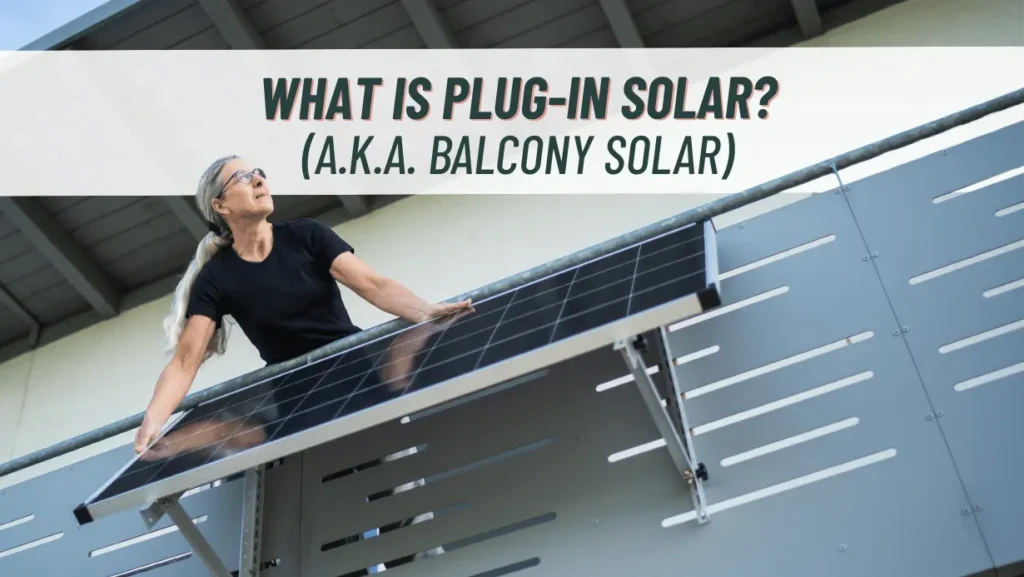
For many people, going solar still means installing solar panels on a rooftop. But a growing trend called plug-in solar (or balcony solar) is expanding access to solar energy beyond traditional homeownership.
Known as plug-in solar, balcony solar, or plug-and-play solar, these small, portable systems are designed to help households generate some of their own electricity without a full rooftop solar installation. They have become increasingly popular in parts of Europe, particularly Germany, where balcony-mounted solar panels are now a common sight.
In the United States, plug-in solar is still emerging, but interest is growing as new safety standards and proposed legislation begin to shape the market. Oregon lawmakers even considered plug-in solar legislation during the 2026 session, highlighting a larger question that is likely to remain relevant: Could smaller, more accessible solar panel systems help bring affordable, renewable energy to people who cannot install traditional rooftop solar?
What Is Plug-In Solar?
Plug-in solar is a small-scale solar energy system designed to connect to a household electrical circuit through an outlet rather than through a permanent hardwired connection to an electrical panel.
A typical system may include:
- One or more compact solar panels
- A microinverter that converts direct-current electricity into alternating-current electricity
- A mounting system for a balcony, patio, deck, backyard, exterior wall, or other sunny location
- A cord and plug designed to connect the equipment to an appropriate electrical receptacle
- Safety controls intended to prevent overloads and other electrical hazards
- Optional battery storage, depending on the product
The nickname balcony solar comes from one of the technology’s most visible uses: mounting panels on the railing of an apartment balcony. However, a balcony is not required. These panels may also be placed on a patio, a deck, in a yard, or in another area that receives adequate sunlight.
Plug-in solar technology fills a different role than a conventional rooftop solar panel system. Plug-in solar is not usually intended to power an entire home. Instead, it is designed to offset a modest portion of a household’s daytime electricity consumption.
See the comparison between plug-in solar and rooftop solar below.
How Does Plus-In Solar Work?
Solar panels generate electricity whenever they are exposed to sunlight. Like the panels used in a rooftop system, balcony solar panels produce direct-current (DC) electricity. A small inverter converts that energy into alternating-current (AC) electricity, which is the type of power used by most household appliances.
In a plug-in solar system, the converted electricity enters the home through an appropriate electrical outlet. The electricity can then help power devices that are already running inside the home.
For example, a small plug-in solar system may help offset some of the electricity used by a refrigerator, Wi-Fi router, computer, television, or other everyday household loads. When the panels are not producing enough energy, the home continues to draw electricity from the utility as usual.
This is one of the most important distinctions to understand: plug-in solar reduces the amount of utility electricity a household needs to purchase, but it does not normally replace the utility grid.
The results also depend heavily on timing. A plug-in system is most useful when the household is actively consuming electricity while the panels are generating energy. Without a compatible battery or another way to store excess power, unused solar energy may not provide the homeowner or renter with an additional financial benefit.
Another important consideration is net metering. Traditional rooftop solar systems are typically connected through a utility-approved interconnection process that allows excess electricity to flow back to the grid and earn bill credits under applicable net-metering rules. Plug-in solar systems generally do not have the same established net-metering benefit. Whether excess electricity can be exported to the grid—and whether a customer would receive any credit for that energy—depends on state regulations, utility policies, and the specific design and certification of the system.
Because plug-in solar regulations are still evolving in the United States, consumers should not assume that a balcony solar system automatically qualifies for net metering. In many cases, the primary financial benefit comes from using the solar electricity directly within the home as it is generated rather than exporting excess energy to the utility grid.
Learn more about net-metering and how it benefits solar owners.
Why Is Balcony Solar Becoming More Popular?
The biggest appeal of plug-in solar is accessibility.
Traditional rooftop solar can provide substantial long-term savings, but it is not a realistic option for every household. Renters generally do not have permission to make major structural changes to a property. Apartment residents may not control the roof. Some homeowners have shaded roofs, aging roofs, or other site conditions that make a conventional installation difficult.
Plug-in solar offers a smaller entry point for solar ownership and energy savings.
A Solar Option for Renters & Apartment Residents
Balcony solar could give renters and residents of multi-unit buildings a way to participate in solar energy without owning a roof.
A renter with a sunny balcony or patio may be able to install a portable system that can be removed and taken along during a future move. This makes plug-in solar especially appealing for households that have historically had limited access to renewable energy options.
A Lower Upfront Cost
A plug-in solar kit is much smaller and less complex than a professionally installed rooftop solar array. As a result, the upfront cost is generally lower.
The tradeoff is equally important: a smaller solar panel system will produce less electricity. Plug-in solar may lower a power bill, but the savings are typically more modest than the savings available from a properly designed rooftop or ground-mounted system.
How much could you save with solar? Use our Solar Calculator to find out!
A Simpler Installation Process
Plug-in solar is also much easier and simpler to install than conventional rooftop solar, and can often be a DIY project.
However, “simpler” does not mean that every product can safely be connected to every home. Product certification, mounting requirements, electrical rules, building codes, lease restrictions, and utility requirements still matter.
Is Plug-In Solar the Same as Portable Solar?
The terms plug-in solar and portable solar are sometimes used interchangeably, but they do not always mean the same thing.
A portable solar panel connected to a portable battery or power station is generally designed to charge the battery directly. The stored energy may then power specific devices, appliances, camping equipment, or emergency essentials.
A plug-in solar system is different because it is designed to connect to a household electrical circuit and supply electricity to the home.
That distinction is quite important. Connecting solar equipment to a home’s wiring introduces additional safety considerations. A product that is appropriate for charging a portable battery is not automatically appropriate for plugging into a household outlet.
Consumers should never assume that any solar panel, battery, inverter, or extension cord can be combined into a safe do-it-yourself household energy system. If you are unsure how to setup your system or if it’s safe to do so, contact your local solar company or electrician.
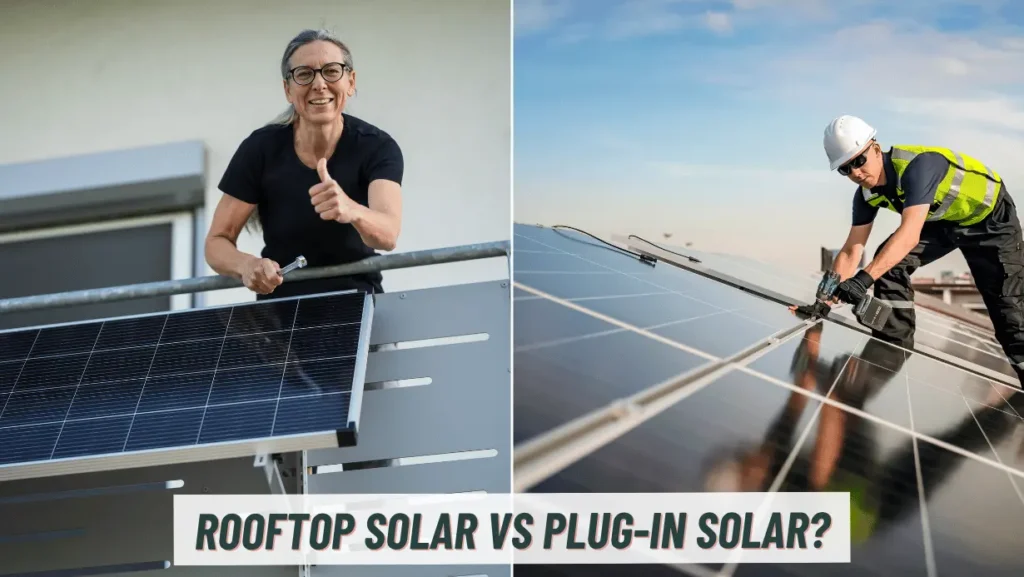
How Does Plug-In Solar Compare With Rooftop Solar?
Balcony solar and professionally installed rooftop solar both generate renewable energy from sunlight, but they serve different needs and provide different benefits.
| Plug-In or Balcony Solar | Professionally Installed Rooftop Solar |
|---|---|
| Small and portable | Permanent and customized for the property |
| Designed to offset a limited portion of electricity use | Designed to offset a substantial share of household electricity use |
| May be practical for renters or apartment residents | Most practical for homeowners, businesses, and property owners |
| Lower upfront cost | Larger investment with greater long-term savings potential |
| Limited generating capacity | Sized around energy usage, available space, and long-term goals |
| May use an outlet-based connection if permitted | Permanently connected to the home’s electrical system |
| Emerging regulations and safety requirements in the United States | Established permitting, inspection, and utility-interconnection process |
| May be portable when a resident moves | Typically stays with the property |
Portability & Installation
One of the biggest differences between the plug-in solar and conventional rooftop solar is permanence. Plug-in solar systems are generally designed to be portable and may be moved from one residence to another, making them appealing for renters or people who expect to relocate. Rooftop solar systems are permanent installations that are engineered specifically for a property and typically remain with the home when it is sold.
Energy Production & System Size
Balcony solar systems are intended to offset a relatively small portion of a household’s electricity consumption. Their compact size limits how much energy they can generate. In contrast, rooftop solar systems are custom-designed around a property’s energy needs, available roof space, and long-term goals, allowing them to offset a much larger share of electricity usage.
Cost & Long-Term Value
Plug-in solar generally requires a lower upfront investment because the systems are smaller and simpler. However, lower cost also means lower energy production and more modest savings. Rooftop solar typically involves a larger initial investment, but it can provide significantly greater long-term savings by generating much more electricity over the life of the system.
Who Each Option Is Best For
Balcony solar may be attractive for renters, apartment residents, condominium owners, or anyone who does not have access to a suitable roof. Rooftop solar is usually the better fit for homeowners, businesses, and property owners who want to maximize energy production and long-term financial benefits.
Electrical Connection & Infrastructure
Many plug-in solar systems are designed around outlet-based connections where permitted by applicable regulations. Because this approach differs from traditional solar installations, it raises unique safety and code considerations. Rooftop solar systems are permanently connected to a building’s electrical infrastructure through established installation, permitting, inspection, and utility-interconnection processes.
Regulations & Safety Standards
The regulatory environment for plug-in solar is still evolving in the United States. New standards and proposed legislation are helping define how these systems can be used safely. Rooftop solar, by comparison, operates within a mature framework of electrical codes, permitting requirements, inspections, and utility procedures that have been refined over many years.
Moving Versus Staying With the Property
A portable plug-in solar system may be one of the few renewable-energy options that can potentially move with a renter or resident. Rooftop solar systems are considered part of the property and are intended to provide value over decades of operation at a fixed location.
Plug-in solar should not be viewed as a replacement for rooftop solar. It is better understood as another option within a wider range of clean-energy solutions.
For a renter who cannot install rooftop solar, a small portable balcony solar system could be a meaningful way to offset some daytime electricity use. For a homeowner trying to reduce a large power bill, prepare for utility rate increases, add battery backup, or achieve greater energy independence, a professionally designed solar and battery system will usually provide much more value.
How Much Electricity Can a Balcony Solar System Produce?
The amount of energy a plug-in solar system can generate depends on several factors:
- The number and wattage of the solar panels
- The output capacity of the inverter
- The amount of direct sunlight available
- The direction and angle of the panels
- Seasonal weather patterns
- Shade from nearby buildings, trees, railings, or other obstructions
- The household’s electricity consumption while the panels are producing power
- Whether the system includes compatible battery storage
A sunny, south-facing patio will typically provide better results than a shaded balcony with limited direct sunlight. Seasonal differences also matter. A system may produce much more energy during long, sunny summer days than it does during an overcast Oregon winter.
Even under good conditions, plug-in solar is typically a supplemental energy source. It may help reduce the electricity a household purchases from the utility, but a few compact panels are unlikely to support major loads such as electric heating, central air conditioning, an electric water heater, or regular EV charging.
Can Balcony Solar Provide Backup Power During an Outage?
No, balcony solar cannot automatically provide backup power in an outage.
This is an important point because solar panels and backup power are often confused.
Most grid-connected solar systems are designed to shut down during a power outage unless they are paired with compatible battery storage and the necessary safety equipment. This protects utility workers and prevents electricity from unexpectedly flowing onto power lines while repairs are underway.
Read more about why solar panels alone don’t provide power in outages.
The same general principle applies to plug-in solar. A basic outlet-connected solar system should not be assumed to keep a home powered during an outage.
Some plug-in solar products may include or connect to battery storage, potentially allowing stored energy to support selected essential devices. However, the capabilities vary significantly by product. A household interested in backup power should carefully verify what the equipment is designed to do, which devices it can support, and whether it meets applicable safety standards.
For homeowners who want dependable backup power during outages, a professionally installed battery system remains the more robust solution. A properly designed home battery system can be configured around the household’s priorities, such as refrigeration, lighting, internet access, well pumps, medical equipment, or other essential loads.
Learn more about battery backup. You can also request your battery backup analysis to see how you could benefit.
Is Plug-In Solar Safe?
Plug-in solar has the potential to expand solar access, but it also introduces safety questions that should not be overlooked.
A traditional rooftop solar array is designed, permitted, inspected, and connected by professionals. A plug-in solar system is intended to be simpler, but it still sends electricity into a household circuit. That requires safeguards.
UL Solutions, a global leader in applied safety science, launched a dedicated testing and certification program for plug-in solar systems in January 2026.
The UL framework addresses risks that can arise when solar equipment connects to household wiring through a receptacle. These risks include overloaded circuits, accidental contact with hazardous electrical components, improper installation, and electricity flowing in an unintended direction.
Consumers should be cautious about purchasing unverified products online or attempting improvised installations. Important questions include:
- Has the product been evaluated and certified for its intended use?
- Is the outlet suitable for the equipment?
- Can the circuit safely accommodate the additional electricity?
- Does the system include safeguards to prevent overloads?
- Does it shut down appropriately during an outage?
- Is the mounting system secure enough to prevent panels from falling or coming loose?
- Could the panels obstruct a walkway, balcony exit, or emergency escape route?
- Does the installation meet local building, electrical, utility, lease, and homeowner-association requirements?
The phrase “plug-and-play” solar can make the technology sound as simple as plugging in a lamp. In reality, connecting energy-generating equipment to a home requires a higher level of care. Consult your local solar company or electrician to ensure your safety.
Are Plug-In Solar Systems Recognized by Electrical Codes?
The regulatory landscape for plug-in solar is still developing in the United States.
UL Solutions has noted that the 2026 National Electrical Code, like earlier editions, does not recognize the use of plug-in photovoltaic modules. UL 3700 was developed to help address the safety risks associated with this emerging category of equipment.
This does not mean that balcony solar has no future in the United States. It means that safety standards, product certification, electrical codes, state legislation, and utility policies are still catching up with the technology.
Consumers should not assume that a system is permitted simply because it can be purchased online. Before installing any equipment that connects to household wiring, residents should verify the current rules that apply to their location and property and work with a certified solar company or electrician for installation.
What Happened With Oregon’s Balcony Solar Proposal?
Oregon lawmakers considered plug-in solar legislation during the 2026 short session.
House Bill 4080 would have allowed retail electricity customers to install and use portable solar photovoltaic devices with a combined generating capacity of up to 1,200 watts. The proposal also included provisions related to utility notification, landlord restrictions, homeowner associations, condominium associations, and potential updates to the state building code.[4]
The bill generated interest because it could have established a clearer path for renters, apartment residents, and other households interested in smaller solar systems.
It also generated concerns. During the legislative discussion, electricians and firefighters raised questions about electrical safety, the capacity of household outlets, compliance with electrical codes, and the possibility that panels could obstruct balconies or emergency exits.
HB 4080 did not advance during Oregon’s 2026 legislative session.
That means Oregonians should not treat plug-in solar as a broadly approved, standardized program. Residents should verify applicable electrical, building, utility, landlord, and homeowner-association rules before purchasing or installing equipment.
The proposal may still be significant in the long term. Even though the bill did not pass, it reflects growing interest in smaller and more accessible solar options. Similar discussions are likely to continue as products evolve and national safety standards become more established.
Who Might Benefit From Plug-In Solar in the Future?
As technology and regulations develop, balcony solar could become a useful option for:
- Renters with a sunny balcony, patio, deck, or yard
- Apartment or condominium residents who cannot install rooftop panels
- Homeowners with limited space or challenging roof conditions
- People interested in starting with a smaller solar investment
- Households looking to offset a modest amount of daytime electricity use
- Residents interested in pairing a portable solar system with compatible battery storage for selected devices
The key word is modest.
A small solar system can make renewable energy more accessible, but it will not deliver the same results as a complete home-energy solution. The right choice depends on the customer’s property, budget, energy usage, and long-term goals.
When Does a Full Solar Installation Make More Sense?
For many Oregon homeowners, a professionally installed solar array remains the stronger option.
A full rooftop or ground-mounted system may be a better fit if you want to:
- Reduce a larger portion of your monthly electricity bill
- Protect your household from long-term utility rate increases
- Design the system around your home’s actual energy usage
- Add battery backup for outages
- Support larger household loads
- Prepare for future electricity needs, such as an EV or electric appliances
- Install a permanent system with established permitting, inspection, and utility-interconnection procedures
- Work with a local team that can provide long-term service and support
A professionally designed system also allows for a more complete evaluation of your property. An experienced solar installer can review your electricity usage, roof condition, sun exposure, shading, electrical infrastructure, battery goals, and other factors before recommending a solution.
Contact Green Ridge Solar today for you free solar analysis. Learn how much you could save with solar and see a model of solar panels on your property. Request your solar analysis today!
A More Accessible Solar Future
Plug-in solar is an interesting an appealing development in the renewable-energy industry.
It could help broaden solar access for renters, apartment residents, and households that cannot install traditional rooftop panels.
In the United States, the technology is still evolving. New safety standards are creating a clearer framework, but state laws, electrical codes, utility requirements, and product options remain works in progress.
For Oregon residents, the best approach is to stay informed and proceed carefully. Plug-in solar may become a more common option in the future, but consumers should verify the rules and choose certified equipment before connecting any solar product to a household electrical system.
For homeowners who are ready to make a larger impact on their power bills, a professionally installed solar or solar-plus-battery system remains one of the most effective ways to take control of rising electricity costs.
At Green Ridge Solar, we design solar and battery systems around the needs of Oregon and Washington homes, businesses, and property owners. Our local team can help you understand your options and determine which energy solution makes the most sense for your property.
Interested in exploring solar or battery backup for your home? Contact Green Ridge Solar to get a free quote.
