
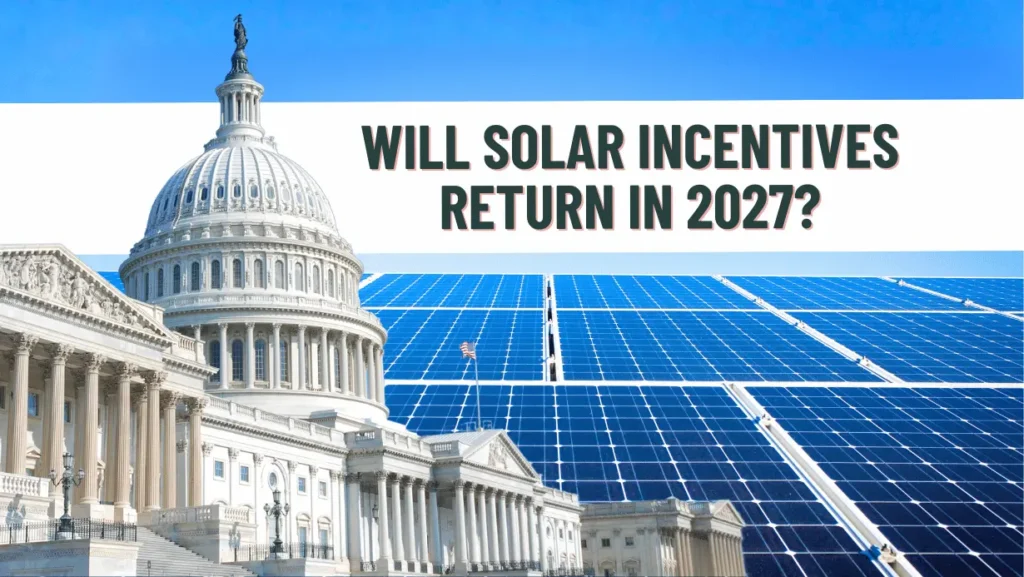
Could the federal solar tax credit make a comeback? Following the 2026 midterm elections and democratic wins in Congress, the future of solar and battery incentives could be back on the table. Here’s what homeowners and businesses need to know.
The political landscape in Washington, D.C., has shifted dramatically following the November 3, 2026, midterm elections. Democrats have won control of both the U.S. House of Representatives and Senate, setting the stage for a new era of divided government and potentially significant changes to federal energy policy.
For homeowners and businesses considering solar energy, one question stands out: Could this mean the return of federal solar tax credits?
In 2025, Congress passed the One Big Beautiful Bill Act (OBBBA), which eliminated the 30% federal residential solar tax credit after December 31, 2025, and significantly shortened the timeline for several commercial solar incentives.
Now, with Democrats preparing to take control of Congress in January 2027, those policies could be revisited.
However, while the election opens the door to potential changes, restoring federal solar incentives is far from guaranteed. Here’s what the election results could mean for solar tax credits, battery incentives, and the future of solar energy in Oregon and across the country.
Estimate your total savings, payments, and total energy usage with our FREE solar calculator.
Where Do Federal Solar Incentives Stand Today?
Before discussing what could change, it’s important to understand where federal solar incentives currently stand.
Residential Solar Tax Credits Expired in 2025
For years, the federal Residential Clean Energy Credit (Section 25D) allowed qualifying homeowners to claim a tax credit worth 30% of eligible solar installation costs.
The credit also covered qualifying battery storage systems, making solar and battery backup considerably more affordable for homeowners.
However, the One Big Beautiful Bill Act (OBBBA), signed into law on July 4, 2025, eliminated this credit for new qualifying installations completed after December 31, 2025.
As a result, homeowners installing a new solar or battery system in 2026 generally cannot claim the former 30% federal residential solar tax credit.
That’s a significant change from previous legislation, which had originally scheduled the credit to remain available at 30% through 2032.
Fortunately, the expiration of the residential tax credit doesn’t mean homeowners are out of options. State and utility incentives, along with alternative solar financing arrangements, continue to provide opportunities to reduce installation costs.
Commercial Solar Incentives Remain Available, But Deadlines Are Approaching
Federal incentives for commercial solar projects are a different story.
Under current law, eligible businesses, farms, and other organizations may still qualify for the Clean Electricity Investment Credit (Section 48E), which can cover 30% or more of eligible solar installation expenses when applicable requirements are met.
However, the 2025 legislation dramatically accelerated the expiration timeline for solar projects.
For commercial solar projects that began construction after July 4, 2026, systems generally must be placed in service before January 1, 2028, to qualify for the federal credit.
Projects that established qualifying construction before the July 2026 deadline may follow different rules.
Importantly, qualifying commercial battery storage systems have separate eligibility provisions and are not subject to the same solar-specific termination deadline.
These distinctions make the timing of commercial solar projects especially important.
For a more detailed breakdown, visit our Oregon Commercial Solar & Battery Incentives Guide.
Could Democrats Bring Back the 30% Solar Tax Credit?
One of the biggest questions following the 2026 midterms is whether a Democratic-controlled Congress could restore the solar and battery incentives eliminated in 2025.
The short answer is yes, Congress could pass legislation to restore or extend federal solar tax credits. But whether that legislation becomes law is another matter.
Democratic lawmakers have consistently supported federal clean-energy incentives, and some have already introduced proposals designed to reverse the changes enacted under the OBBBA.
One notable example is the Energy Bills Relief Act (H.R. 7977), introduced in March 2026 by Representative Sean Casten and numerous Democratic cosponsors.
Among its provisions, the legislation proposes repealing the 2025 rollbacks of federal clean-energy tax credits. It also addresses energy costs, community solar, renewable energy development, and grid infrastructure.
The bill has not become law, and it would need to be reintroduced in the new Congress to advance after the current congressional term ends.
Nevertheless, it provides a tangible example of the types of energy legislation Democrats could pursue with their new majorities.
Oregon Senator Ron Wyden has also expressed support for restoring clean-energy tax provisions, including programs that help public agencies and nonprofits invest in renewable energy.
What Solar Incentives Could Be Reconsidered?
Several areas of federal solar policy could receive renewed attention in 2027.
1. Restoring Residential Solar Tax Credits
Congress could consider bringing back the 30% Residential Clean Energy Credit or introducing a modified replacement.
Any new legislation would need to establish eligibility requirements, credit amounts, effective dates, and expiration timelines.
It’s also possible that future incentives could differ considerably from those available before 2026.
2. Extending Commercial Solar Incentives
Another possibility is legislation extending the Clean Electricity Investment Credit beyond its current solar-specific deadlines.
This could provide businesses, farms, nonprofits, and other organizations with more time to plan, finance, and complete solar installations.
Large commercial installations often require months of engineering, permitting, utility coordination, and construction. Longer incentive timelines could provide greater flexibility for these projects.
3. Expanding Battery Storage Incentives
Federal lawmakers could also consider incentives supporting residential and commercial battery storage.
As households and businesses become increasingly concerned about power outages, grid reliability, and electricity costs, battery storage has become an important component of energy planning.
4. Supporting Community Solar and Other Energy Programs
Other potential priorities include community solar development, energy programs benefiting lower-income households, domestic clean-energy manufacturing, and investments in electrical infrastructure.
These initiatives could expand access to solar beyond homeowners and businesses with suitable rooftops.
GET YOUR FREE SOLAR ANALYSIS
Request your FREE solar analysis now!
We’ll evaluate your roof, sun exposure, electricity usage, incentives, and more to help you decide if solar is right for you!
What’s Standing in the Way of Restoring Solar Incentives?
Although Democrats will control both chambers of Congress beginning in January 2027, they will not control the White House.
President Donald Trump remains in office through January 2029, and his administration has supported policies reducing federal incentives for wind and solar energy.
This creates a significant obstacle to restoring the tax credits eliminated in 2025.
For new legislation to become law, it generally must pass both chambers of Congress and receive the president’s signature.
If President Trump vetoes legislation restoring solar incentives, Congress would need a two-thirds majority in both the House and Senate to override that veto.
Additionally, most legislation in the Senate faces procedural hurdles that can require 60 votes to advance.
Consequently, Democratic control of Congress does not automatically mean that federal solar incentives will return.
Any restoration could depend on bipartisan negotiations, changes in legislative priorities, or broader agreements involving taxes, energy costs, and government spending.
In the meantime, congressional leaders can still influence federal energy policy through legislation, government funding decisions, and oversight of existing programs.
What Does This Mean for Oregon Homeowners & Businesses?
Regardless of what happens in Washington D.C., Oregon homeowners and businesses still have important decisions to make about their energy costs.
While federal incentive changes could affect the economics of solar, other factors remain just as relevant, including rising utility rates, available rebates, financing options, and long-term electricity savings.
For Oregon Homeowners: Solar Incentives Still Exist
Although the federal residential solar tax credit expired, eligible Oregon homeowners may still have access to other programs.
For example, Energy Trust of Oregon (ETO) offers incentives for qualifying solar and battery installations for customers of Portland General Electric (PGE) and Pacific Power. Additional assistance may be available to income-qualified households.
Oregon Department of Energy (ODOE) also maintains its Solar + Storage Rebate Program, although its most recent funding allocation was fully reserved in June 2026, and the program is not currently accepting new rebate reservations.
Another option worth exploring is third-party-owned (TPO) solar, including certain solar leases and energy service agreements.
These arrangements allow homeowners to benefit from solar energy without purchasing and owning the equipment outright. Instead, a third-party provider owns the system, potentially qualifying for business-related federal incentives that are not available directly to homeowners.
Depending on the agreement, the homeowner may benefit from reduced upfront costs and ongoing energy savings, although payment terms, escalation rates, and long-term obligations vary.
With several options available, it’s important to compare the full costs and benefits of solar ownership, financing, and third-party arrangements.
Explore our Oregon Solar Incentives Guide to learn more and see what solar and battery incentives you qualify for.
For Oregon Businesses: The Incentive Clock Is Still Ticking
For businesses, farms, and commercial property owners, the upcoming federal solar incentive deadlines present a different consideration.
Although Congress could eventually extend commercial solar credits, the existing deadlines remain in effect unless new legislation changes them.
That means businesses considering solar in 2027 should understand whether their project could qualify under current law.
In addition to federal tax credits, qualifying businesses may benefit from accelerated depreciation, utility incentives, and other financial programs.
For larger installations, these incentives can have a significant impact on project economics and long-term returns.
Businesses considering solar should begin evaluating their options early enough to account for system design, financing, permitting, and installation.
Read more in our article, Commercial Solar in 2027: Why Businesses Should Start Planning Now.
Should You Wait for Federal Solar Tax Credits to Return?
With a new Congress preparing to take office, some homeowners and businesses may be tempted to postpone solar installations in hopes that federal incentives will return.
It’s certainly understandable. A tax credit covering 30% of installation costs can make a substantial difference in the overall investment.
However, waiting comes with uncertainty and costs.
There is currently no guarantee that Congress will restore the residential solar tax credit, extend commercial incentives, or establish new programs. Even if legislation eventually passes, future eligibility requirements and effective dates remain unknown.
And there is no assurance that any future incentives would apply retroactively to installations completed before a new law takes effect.
Meanwhile, electricity costs remain an ongoing concern for Oregon households and businesses.
Customers of PGE and Pacific Power have already experienced substantial rate increases in recent years, with additional increases proposed for 2027.
Solar offers an opportunity to generate electricity on-site, reduce the amount purchased from the utility, and gain greater predictability over long-term energy expenses.
Delaying your solar installation can mean delaying those potential savings.
For businesses, waiting may also create the risk of missing existing federal incentive deadlines.
Rather than making a decision based entirely on potential legislation, homeowners and businesses should evaluate solar using the incentives, financing options, installation costs, and projected savings available today.
If new incentives emerge in the future, they can be evaluated when their details become clear.
What’s Next for Solar Incentives in 2027?
The 2026 midterm elections have changed the political landscape surrounding federal energy policy, and the coming year could bring renewed debate over solar tax credits and renewable energy investments.
With Democrats controlling Congress, proposals to restore residential solar credits, extend commercial incentives, and expand battery storage programs could receive greater legislative attention.
However, significant political and procedural obstacles remain, and the future of federal solar incentives is far from certain.
For Oregon homeowners and businesses, the key is to stay informed while keeping sight of the broader financial benefits solar energy can provide.
At Green Ridge Solar, we’re continuing to monitor federal and state incentive developments so we can help our customers understand their options and make informed decisions.
Whether you’re considering solar for the first time, exploring battery backup, or planning a commercial installation, our team can help you evaluate available incentives, financing opportunities, and long-term energy savings.
Interested in seeing what solar could mean for your home or business? Contact Green Ridge Solar for a personalized solar analysis and discover what options are available today.
Estimate your total savings, payments, and total energy usage with our FREE solar calculator.
